
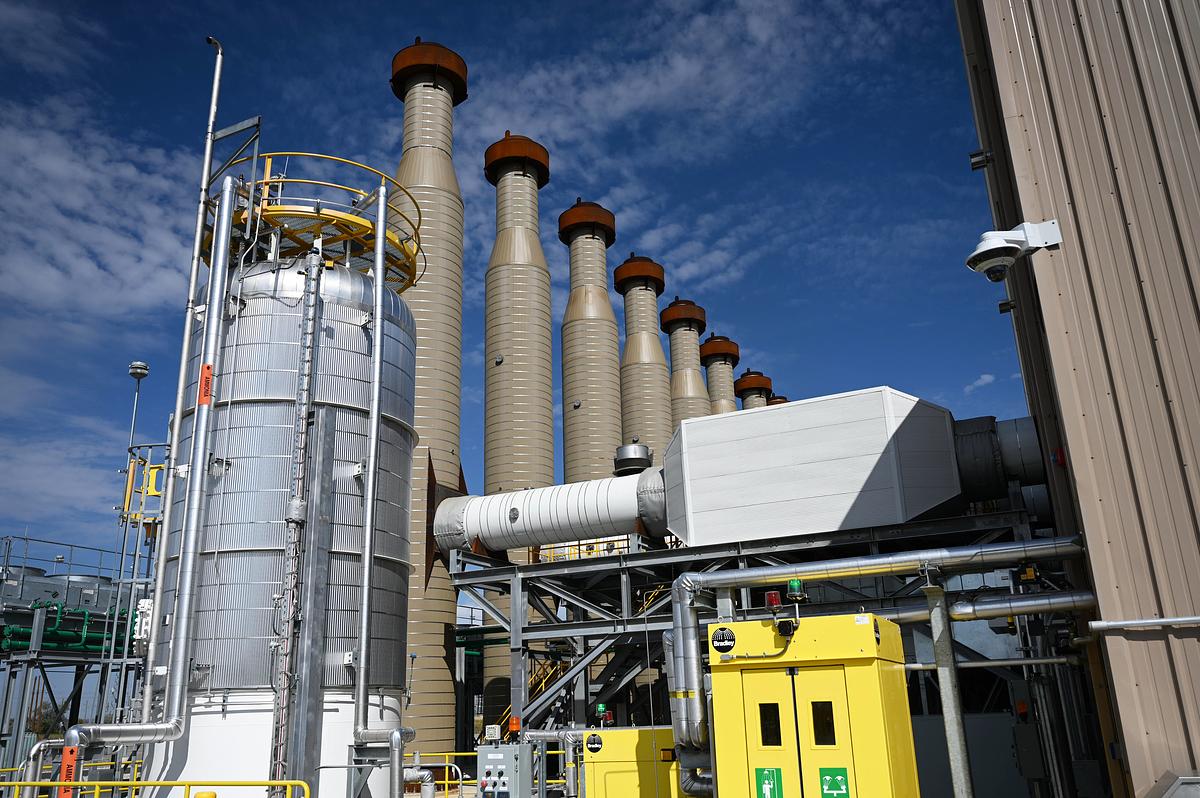

LAUREL — For Tim and Amy Grandpre, a small slice of land off a gravel road southeast of town, not far from the banks of the Yellowstone River, has been their slice of paradise for decades.

The grass around their house, nestled in a slight hollow shaded by cottonwoods, stays green through the summer without being watered. Chicken coops and neat stacks of firewood are testament to long hours spent making the property a home. Amy, who taught gardening classes for the county extension office before her retirement, tends rows of vegetables in homemade greenhouses.
Most of the surrounding land is a swath of open fields traversed by irrigation ditches. Recent years, though, have brought the Grandpres a new next-door neighbor: NorthWestern Energy’s $316 million, 175-megawatt Yellowstone County Generating Station.
The new plant, among the most hotly disputed industrial developments in recent Montana history, is central to a yearslong debate about how NorthWestern should generate electricity. While environmental groups have pressed the utility to embrace renewable generation, the new natural gas-powered plant represents a concrete-and-steel investment in fossil fuels over its 30-year service life. NorthWestern, which has committed to carbon neutrality by 2050, insists that on-demand gas generation remains necessary to keep Montana’s energy supply reliable — and that it’s capable of mitigating byproducts like air pollution and noise.
In Laurel, where the plant has been in operation for 18 months, neighbors say those more immediate environmental concerns are top of mind.
The small city on the western outskirts of Billings is among the Montana communities where a lively local agriculture scene coexists with some of the state’s heaviest industries. Drivers on Interstate 90, which runs half a mile north of the Grandpres’ home, have a panoramic view of the towering stacks of the CHS Laurel Refinery, often accompanied by a whiff of burnt-rubber odor some locals call “the smell of money.” Just across the interstate, BNSF Railway operates a major switchyard adjacent to the local Walmart.
For NorthWestern, the investor-owned utility that provides electricity to 413,000 Montana customers, the confluence of an adjacent substation, access to an existing natural gas pipeline and proximity to Billings-area customers made a field outside Laurel an ideal location for a major addition to its generating portfolio. Eighteen 78-foot exhaust stacks, one for each of the plant’s natural gas-powered engines, add a row of new towers to the town’s industrial skyline.
Each engine is designed to spin up with a few minutes’ notice, giving the company the ability to rapidly adjust how much electricity it’s generating. NorthWestern says that on-demand flexibility is vital to its efforts to manage its power grid, especially as the company incorporates more generation from weather-dependent wind and solar.
Guiding MTFP journalists around the facility last month, NorthWestern project manager Josh Follman, who oversaw the plant’s construction, showed off its 86 miles of color-coded power cables and spark plugs the size of kitchen trash cans. He also took pains to point out numerous features intended to make the plant a responsible neighbor — among them, dark sky-compliant outdoor lighting, filters that scrub trace pollutants from its exhaust, and sound-dampening measures that muffle the generators’ roar.
“Unfortunately, you’ve got to have power plants. It’s just the nature of the beast,” Follman said. “You want to try to keep them as clean as possible and you want to keep it as least intrusive as you can. And I think we’ve done a pretty good job.”
From the moment the facility was formally proposed in 2021, it has been a lightning rod for public debate. Local and national environmental groups mobilized in opposition, alleging the plant would impair local air quality and spew climate-warming carbon dioxide. Critics have also argued that NorthWestern can provide customers with reliable service without burning more fossil fuels, calling the new power plant an unnecessary way to pad the company’s bottom line at ratepayer expense.
Last fall, for example, the Billings-based Northern Plains Resource Council led a “Stop Godzilla” protest float on the Yellowstone River. Signs labeled the plant a “methane monster” and accused the company of “Poisoning Hard Working People and the Planet for Predatory Profits.”
The opposition also took to court, litigating the plant’s local zoning approval and state environmental review, with the latter case eventually landing before the Montana Supreme Court. While construction was delayed for two months in 2023 following a lower court ruling, the company otherwise forged ahead undeterred.
The plant first fired up in March 2024 and was substantially completed last fall, producing power for Montana customers and for sale to other utilities. As of this month, 16 of the 18 generating units are fully online as operators work to troubleshoot start-up issues with the other two, according to NorthWestern staff.
The company says the facility employs 22 workers and expects to pay a $3.41 million tax bill this year. Because the plant is located outside Laurel city limits, that bill doesn’t help pay for city services, but does include taxes for Laurel Public Schools.
Even so, the plant remains a high-voltage hot potato. An ongoing case before Montana’s utility-regulating Public Service Commission will determine how much of the plant’s price tag will be passed along to NorthWestern’s customers in the form of higher power bills. The facility’s generating capacity may also become a factor as NorthWestern, which is proposing a merger with a South Dakota utility, looks for ways to serve power-hungry artificial intelligence data centers.
Across the Yellowstone River, a little less than a mile southwest of the plant, Carah Ronan is a NorthWestern neighbor, but not a customer. The small organic flower farm she and her husband run on eight acres gets its power from a rural electric cooperative.
Nonetheless, the plant’s exhaust stacks peek through the trees as Ronan tends her flowers, which she cuts for sale at grocery stores in Bozeman and Red Lodge. As she paused during an interview on a still August evening, their low rumble hummed like a jet plane idling in the distance.
Ronan, who has farmed on the property since 2021, said she’s accustomed to intermittent noise from trucks on the highway to Red Lodge and the noon bell ringing at the Laurel refinery, which sometimes reminds her to eat lunch. But she finds the perennial drone of the new power plant more irritating.
“It’s consistently there now as a background noise, so there’s no listening to the water or the birds or the toads at night,” she said. “You hear that sound 24/7. And that is not amazing.”
Ronan’s 91-year-old grandmother, Nita Rowland, first moved to the property in 1962. She said noise from the plant feels like a “tremor.”
“It shakes the whole house all night now,” Rowland said.
Ronan also worries about a plant-feeding gas pipeline she saw installed near her home’s sole access road, saying an incident could leave her family trapped.
Along with other neighbors along Thiel Road, which runs south of the river, Ronan opposed the plant in its planning stages, weighing in at public meetings. A coalition of neighbors was a plaintiff in the litigation challenging the facility’s zoning approval.
Ronan said she remains frustrated about what she described as NorthWestern’s failure to mend fences with her and her neighbors.
“They know they’ve pissed off everyone over here by putting in the plant,” Ronan said. “It would take them a half a day to come out and talk to all of us.”
Sitting in the shade of their garage on a sunny August day, the Grandpres were more upbeat about their relationship with the company and the heavy industry it planted across the property line from their backyard. Multiple company staffers shared their cell phone numbers, they said, and South Dakota-based CEO Brian Bird even visited. Told that Follman, the NorthWestern construction engineer, was in town to meet with MTFP reporters, Tim Grandpre said he was going to call him to set up lunch.
“Very open book,” Amy Grandpre said about the company’s interaction with the couple. “They were very forthcoming to visit with us.”
“But they were going to do it. They didn’t ask permission,” Tim Grandpre added.
Follman said the facility’s footprint was designed to minimize impacts on the Grandpres, placing the plant’s parking lot on their side of the company’s property to buffer them from the generators. NorthWestern built a berm to help shield the couple’s home from noise and planted view-diffusing saplings on top.
The steady stream of semis and cement trucks rumbling past their home made for a rough couple of years while the plant was under construction, the Grandpres said. But today they’re relatively unbothered by the facility, saying it’s less of a nuisance than the refinery, the interstate and passing trains. As the couple chatted with reporters, the hum of the power plant was drowned out by buzzing cicadas.
“It’s almost like it was before,” Amy Grandpre said.
The couple said they had rebuffed outreach from the opposition movement, saying they thought opponents exaggerated how much the plant would change their rural neighborhood.
“Dogs barking and kids screaming and horns blaring — can you imagine living in town? These guys are better neighbors,” Tim Grandpre said.
This story was reported in collaboration with the Laurel Outlook as part of Montana Free Press’ 2025 Reporter Residency program, which places MTFP reporters for weeklong stints in community newsrooms throughout the state. Special thanks to Laurel Outlook reporter Jaci Webb for her insight.
This story was updated Sept. 29, 2025, to use a number that more accurately describes the size of NorthWestern Energy’s Montana electric customer base.
LATEST STORIES
Poll week: How Montanans feel about sales tax, immigration and state officials
We polled Montana voters on an array of issues. Results will roll out the week of March 2.
Where does eastern Montana start? Montanans disagree
Montana is in many ways a land of two halves: a western Montana of snow-capped mountains and national forests joined in political unity with an eastern Montana of wide-open plains and flatland agriculture. It’s a time-honored divide: peaks versus plains, Missoula versus Miles City, Flathead versus Fort Peck lakes. But where exactly is the dividing line?
Montana voters overwhelmingly view cost as a major mental health care hurdle
According to a Montana Free Press-Eagleton Poll, conducted in late 2025 and early 2026, 67% of respondents cited “cost of services” as a major problem when it comes to accessing care. A smaller share, 42%, cited the stigma associated with receiving care as a major problem, while 47% said the same about the travel distance necessary to access services.