

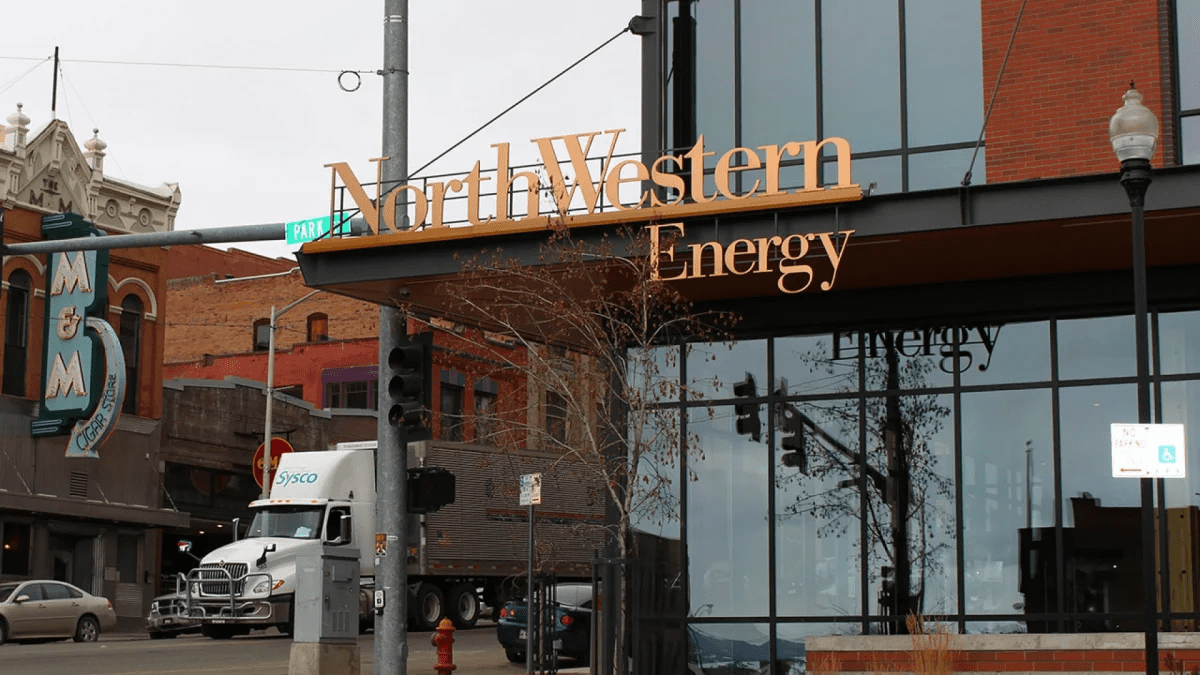
NorthWestern Energy announced this week that it has signed a letter of intent to provide up to 1,000 megawatts of energy to a data center under development by Quantica Infrastructure, a recently launched commercial enterprise that seeks to build “resilient network solutions for AI.”
To supply that much power to Quantica with its existing resources, NorthWestern would have to use virtually every megawatt of electricity the power plants it currently owns are capable of generating, including the newly constructed Yellowstone County Generating Station in Laurel.
NorthWestern, Montana’s largest regulated utility, wrote in a press release that the collaboration “reflects our commitment to innovation, economic development and delivering high-quality energy services.”
“We’re actively working with Quantica to optimize the transmission infrastructure and generation resources needed to support this project,” NorthWestern CEO Brian Bird said in the press release sent Wednesday.
Quantica CEO John Chesser also celebrated the partnership with a comment in the release.
“We are excited to collaborate with NorthWestern to bring a shovel-ready, network-ready site for hyperscalers and AI that utilizes resilient power backed by dedicated renewable energy,” Chesser said.
Quantica did not provide details about the short- and long-term jobs that the data center could create, but did write in an email to Montana Free Press that it is planning to locate its data center in Yellowstone County.
As a shareholder-owned utility, NorthWestern Energy is subject to the regulatory oversight of the Montana Public Service Commission, which reviews increases to electricity and natural gas rates. NorthWestern wrote in its release that it intends to roll Quantica’s new data center into its regulated business to “improve cost efficiency by spreading the fixed costs of operating Montana-based energy infrastructure across a broader customer base.”
Longtime NorthWestern Energy watchdog Anne Hedges, executive director of Montana Environmental Information Center, said in a phone call with Montana Free Press that the “efficiency” referenced in the statement won’t benefit the company’s ratepayers, who can’t shop around for power from another utility.
“We have what we need. Adding [new data centers] to the system should cost them, not us. This should go to NorthWestern’s unregulated arm,” Hedges said, referencing NorthWestern’s ability to sell power directly to new customers in a way that insulates its ratepayers from those transactions and associated risks. “These companies are not viable, they don’t stick around a long time. Who’s going to have to pay for all the costs of the infrastructure and that generation? … Those are going to be stranded assets that are going to be on the backs of the little guys.”
Asked about the PSC’s role in NorthWestern’s acquisition of customers with such large power requirements, PSC Executive Director Alana Lake said the commission is keeping an eye on it.
“New data center loads of this size represent a significant change to NorthWestern’s energy service obligation,” Lake said. “The commission is monitoring the situation closely and working to address this issue with a fair and balanced approach.”
MTFP also asked NorthWestern about the commission’s regulatory role in these circumstances. Company spokesperson Jo Dee Black did not respond to MTFP’s email by publication time Thursday.
Lake said NorthWestern and the PSC disagree about the commission’s authority. Crystal Lail, NorthWestern’s vice president and chief financial officer, argued in a March 2025 letter to the commission that the PSC has no legal authority to exercise in this situation.
“Montana law does not require new large load customers to obtain Commission approval to receive electric supply service from NorthWestern Energy, as such a requirement would be contrary to the legislative intent of House Bill 25 and the Reintegration Act,” Lail wrote, referencing the late 1990s re-regulation push that followed the Montana Power deregulation debacle.
One provision of a law Lail referenced in her letter holds that a public utility like NorthWestern “shall provide electricity supply service” to new retail customers “if the retail customer demonstrates that the provision of electricity supply services to the retail customers will not adversely impact the public utility’s other customers over the long term as determined by the commission.”
Lake added that the PSC has not opened a docket to look specifically into the addition of large new power users to NorthWestern’s rate base, but it has sought more information from NorthWestern on some of the agreements in question.
On an average day, NorthWestern supplies about 760 megawatts of power to its electricity customers in Montana. During times of peak demand, up to 1,300 megawatts may be required to meet its customers’ needs.
NorthWestern is courting at least two other data centers in Montana.
Earlier this year, TAC Data Centers shared plans for a 569-acre plot of land northeast of Great Falls that would require up to 600 megawatts of “critical load” electricity. NorthWestern provided scant details on its negotiations with TAC, but said that a cost-of-service study would be commissioned to determine how infrastructure upgrades would be funded.
NorthWestern has also pursued an agreement with Atlas Power to build a data center in Butte that would require up to 150 megawatts of power. NorthWestern anticipates that project will be operational next year.
NorthWestern is slated to double its share in the jointly owned coal-fired power plant in Colstrip next year. That plant currently has six owners, most of which are based in the Pacific Northwest. The only owners interested in keeping Colstrip operational beyond 2030 are NorthWestern Energy and plant operator Talen Energy.
Quantica’s leadership team includes several executives who’ve previously worked for Talen, including Chesser, who previously worked as Talen’s chief financial officer, and former Talen CEO Charlie Baker.
According to Delaware’s Division of Corporations, Quantica was registered there in late August of 2024.
latest stories
Western Montana U.S. Rep. Ryan Zinke said he won’t seek reelection citing health problems
“I have made the decision to leave office at the end of my fourth term and not seek re-election,” Zinke said Monday in a letter to constituents.
Poll week: How Montanans feel about sales tax, immigration and state officials
We polled Montana voters on an array of issues. Results will roll out the week of March 2.
Where does eastern Montana start? Montanans disagree
Montana is in many ways a land of two halves: a western Montana of snow-capped mountains and national forests joined in political unity with an eastern Montana of wide-open plains and flatland agriculture. It’s a time-honored divide: peaks versus plains, Missoula versus Miles City, Flathead versus Fort Peck lakes. But where exactly is the dividing line?