

This piece is part of MTFP’s 2026 poll week, where we’re exploring data on how Montana voters feel about their elected officials, environmental concerns, immigration enforcement and other issues.
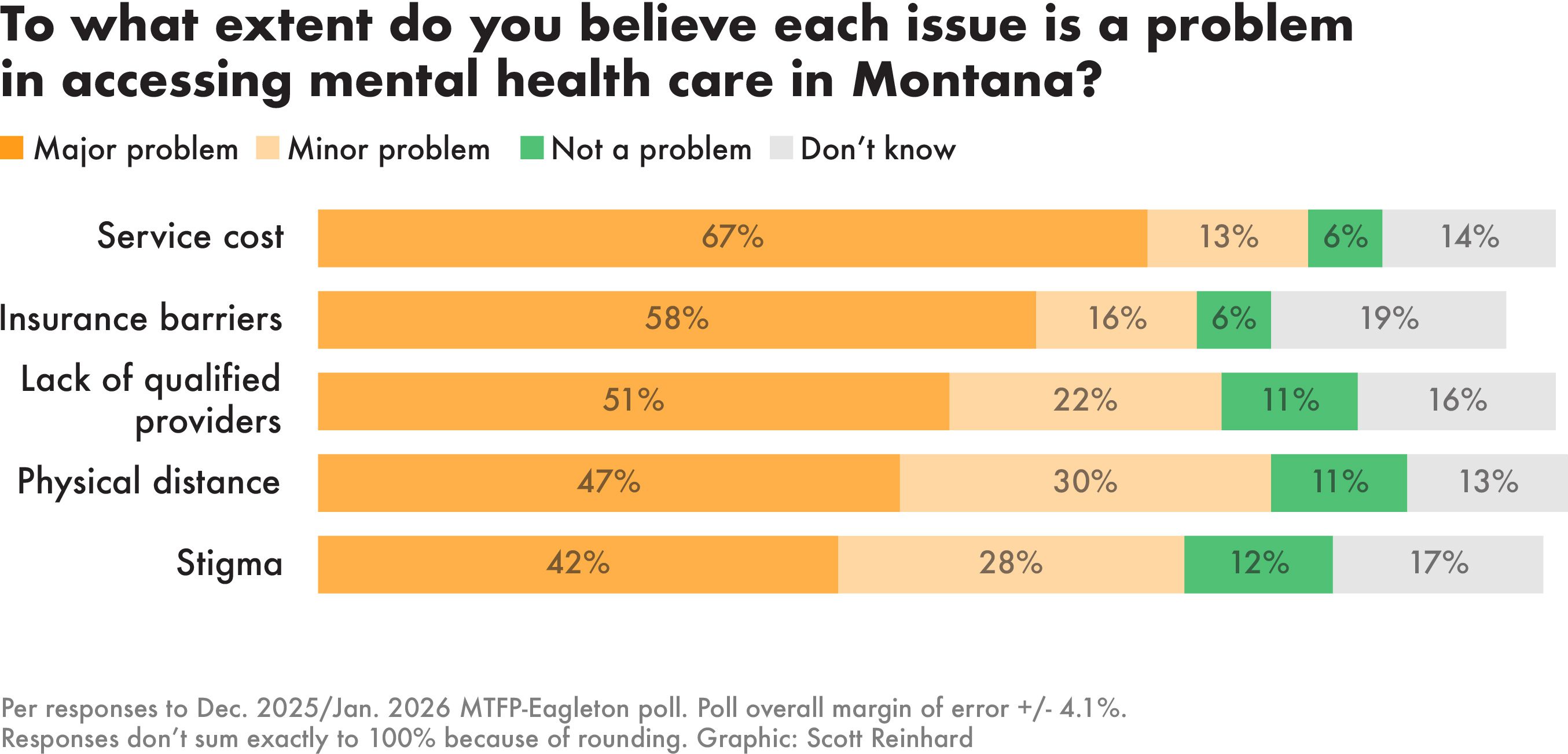
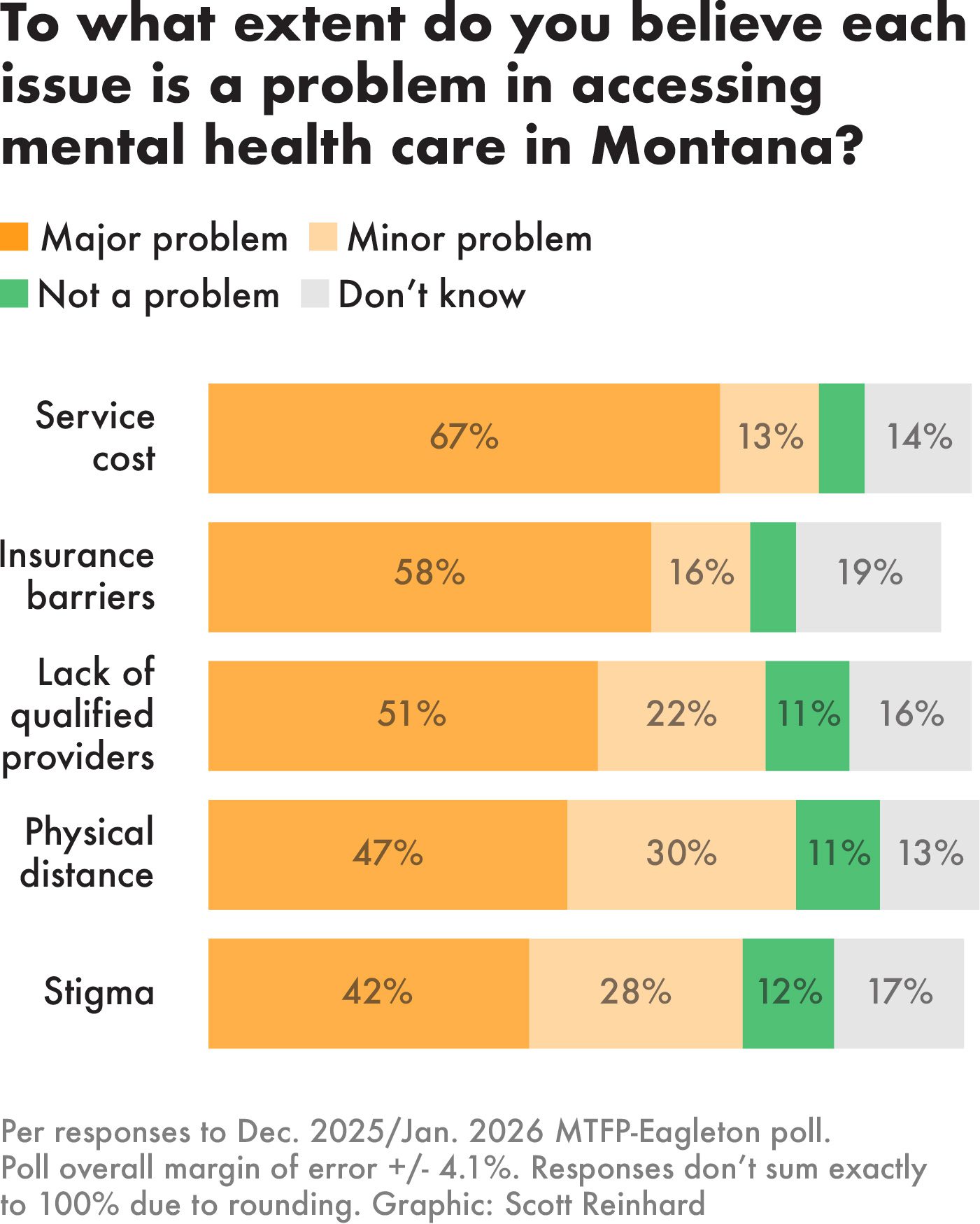
A majority of Montana voters said they see cost and insurance as significant barriers to accessing mental health care — a larger share than those who named physical distance as a major hurdle.
According to a new Montana Free Press-Eagleton Poll, conducted in late 2025 and early 2026, 67% of respondents cited “cost of services” as a major problem when it comes to accessing care. A smaller share, 42%, cited the stigma associated with receiving care as a major problem, while 47% said the same about the travel distance necessary to access services.
Mental health and addiction crises are not uncommon in Montana, with experts describing their causes as complex, entangled and difficult to solve. The state had the second-highest suicide rate in the country in 2023, according to the Centers for Disease Control and Prevention.
Additionally, residents who live in rural areas must often travel hours to reach health care services, and some behavioral health services aren’t available within Montana’s borders at all. Given the state’s strong bootstraps mentality, many mental health care advocates also commonly say stigma deters Montanans from speaking up about mental illness.
That perception breaks down differently between genders. According to the poll results, 35% of men said they saw stigma as a major challenge for mental health access, while that percentage was substantially higher, 50%, for women.
Poll respondents overall, though, named cost and insurance as major problems in greater numbers.
In another part of the poll, 43% of respondents said they had health insurance coverage through their employer or their spouse’s employer, while 29% said they were insured through Medicare. Just six percent of respondents said they were covered through Medicaid, the health insurance plan for low-income adults.
According to a 2021 state-level overview by KFF, a national health policy research firm, Montanans with mental health issues insured through large employer health plans had higher average health spending compared to enrollees without those diagnoses, paying roughly $8,800 annually compared to $3,800.
Brenda Kneeland, the CEO of the Eastern Montana Community Mental Health Center in Miles City, said she’s not surprised that cost and insurance coverage are perceived as major barriers for Montanans seeking mental health care. She said her organization often helps patients navigate insurance gaps, especially if they’ve been disenrolled from Medicaid coverage because of paperwork or documentation errors. People with employer-based insurance, she added, are also not immune from cost struggles.
“Just because they have health insurance through an employer, that doesn’t always mean that there are strong behavioral health benefits tied to the plan,” Kneeland said.
Matt Kuntz, the director of NAMI Montana, a mental health advocacy coalition, said he thinks stigma has been gradually decreasing around mental health issues over the past decade. Kuntz linked some of that change in sentiment to the fact that many military veterans of the Iraq and Afghanistan wars, as well as their friends and family members, have become well-acquainted with the need for accessible mental health care treatment.
“We’ve been having a lot more conversations about mental health in the last decade or two. And I think it’s a more positive conversation,” Kuntz said.
In recent years, high-profile public officials in Montana have launched projects aimed at destigmatizing mental health and addiction treatment, and advocated for policy fixes to make that type of health care more accessible.
Since taking office in 2021, Gov. Greg Gianforte, a Republican, has rolled out a series of initiatives aimed at improving access to treatment for mental health issues and substance use disorder. One of those efforts, a roughly $300 million funding scheme dubbed the Behavioral Health System for Future Generations, held a statewide listening tour about filling treatment gaps for mental health and addiction. Another, the Angel Initiative, works with local law enforcement departments to help route people to addiction treatment services.
At an October meeting between Gianforte and local law enforcement officials, Sweet Grass County Sheriff Alan Ronneberg described mental health as an issue at the root of many people’s struggles, including those with substance use disorder.
“When we’re talking about mental health, not everybody with mental health problems has an addiction problem, but everybody with an addiction problem has a mental health problem,” Ronneberg said. “We need to recognize that.”
The MTFP-Eagleton poll surveyed 801 registered voters through telephone interviews and text-to-web questionnaires. Data was collected from Dec. 23, 2025 to Jan. 3, 2026. The poll, which was weighted to reflect the demographics of the state’s voters, has an overall margin of error of plus or minus 4.1 percentage points.
This piece is part of the Montana Insights project, which commissioned a poll to help MTFP readers understand public sentiment on key Montana policy issues.
other poll stories
75% of voters want Montana to have at least as much federal land as it does now
Federal land transfer has been a party of the GOP party platform at both the state and national level, but a recent MTFP-Eagleton poll indicates that a majority of Republican voters oppose reducing the amount of land in federal ownership.
Montanans want more solar, natural gas development, are less interested in new coal plants
The poll results on Montana’s energy mix come as politicians and policymakers grapple with surging electricity demand spurred by investment in artificial intelligence and the data centers that support it.
Poll week: How Montanans feel about sales tax, immigration and state officials
We polled Montana voters on an array of issues. Results will roll out the week of March 2.