

A version of this story was originally published in the MT Lowdown, a weekly newsletter digest containing original reporting and analysis published every Friday.
Montana’s famous cow-to-person ratio has narrowed a bit. U.S. Department of Agriculture data from early 2024 shows 2.12 million cattle roaming the state alongside 1.14 million people. That’s still nearly two cows for every Montanan, but it’s down from the more dramatic ratios of years past. As recently as 2022, the ratio was more than two cows per person.
Of course, the statewide number only tells part of the story. Drive through rural Petroleum County in the central part of Montana and you’ll encounter one of the most lopsided landscapes in America: 525 people sharing space with more than 32,000 cattle, working out to 62 cows per person. Neighboring Garfield County runs a close second at 59:1, while Powder River County in the southeastern corner of the state clocks in at 50:1.
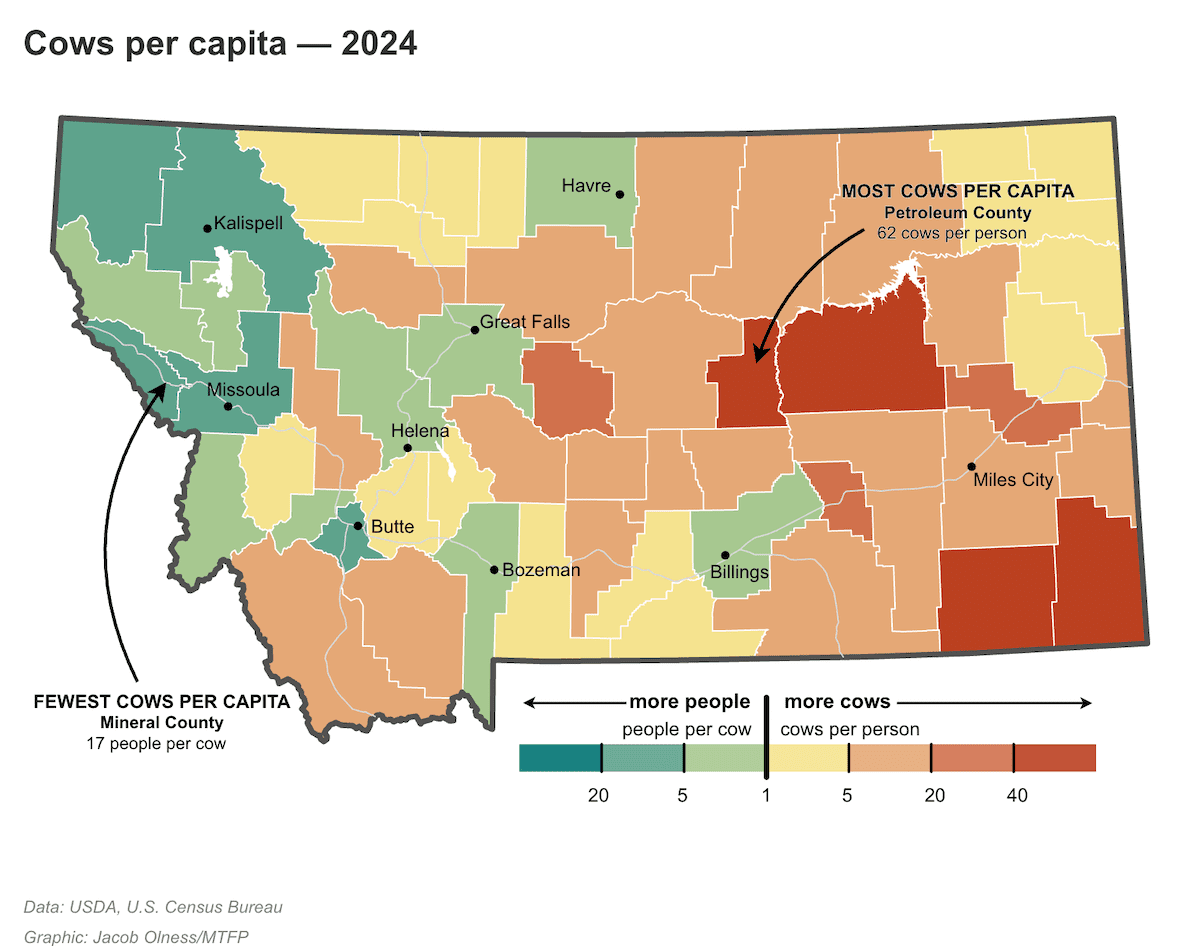
Compare that to urban strongholds like Missoula County, where humans outnumber cattle 15:1. In Yellowstone County around Billings, people hold a 2.5-to-1 advantage — making it the lone eastern county where humans have the numerical advantage. Then there’s Mineral County in heavily forested northwestern Montana, an outlier that doesn’t fit the rural mold. Despite its smaller population, cattle numbers have dropped from 400 to 300 head, giving it the state’s most human-heavy ratio at 17:1.
The raw numbers tell their own story, too. Beaverhead County, around Dillon, leads the herd with 110,000 cattle, while Fergus (Lewistown) and Big Horn (Hardin) each top 90,000. Custer County, home to the livestock hub of Miles City, maintains 86,000 cows among its 12,000 residents — a solid 7:1 ratio that somehow feels modest compared to those eastern plains where cattle still rule by margins of 50 or 60 to 1.
LATEST STORIES
Western Montana U.S. Rep. Ryan Zinke said he won’t seek reelection citing health problems
“I have made the decision to leave office at the end of my fourth term and not seek re-election,” Zinke said Monday in a letter to constituents.
Poll week: How Montanans feel about sales tax, immigration and state officials
We polled Montana voters on an array of issues. Results will roll out the week of March 2.
Where does eastern Montana start? Montanans disagree
Montana is in many ways a land of two halves: a western Montana of snow-capped mountains and national forests joined in political unity with an eastern Montana of wide-open plains and flatland agriculture. It’s a time-honored divide: peaks versus plains, Missoula versus Miles City, Flathead versus Fort Peck lakes. But where exactly is the dividing line?