

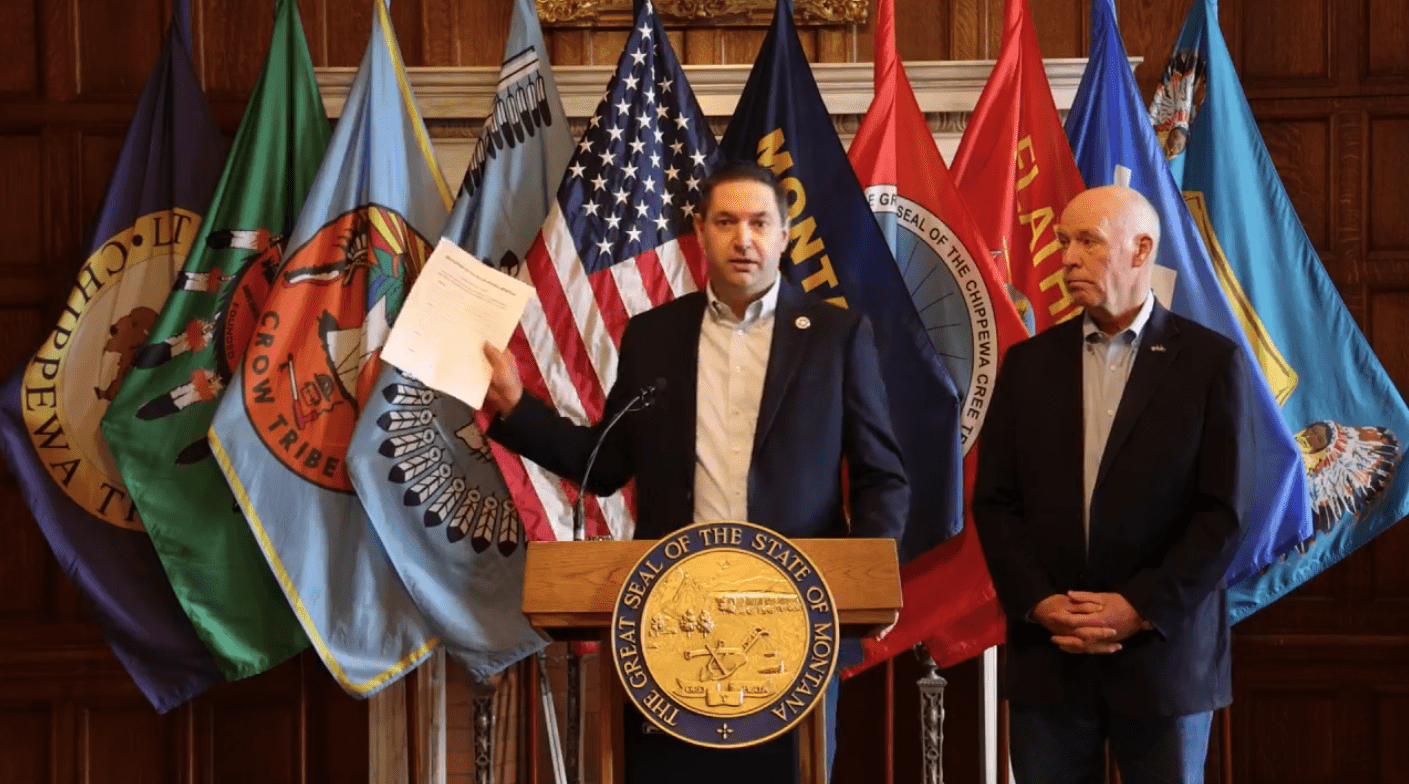
Montana Attorney General Austin Knudsen said he will investigate the city of Helena for stating that it will not assist U.S. Immigration and Customs Enforcement agents.
Knudsen and fellow Republican Gov. Greg Gianforte announced the investigation Wednesday at a joint press conference at the Capitol. Gianforte suggested that Helena appears to have violated a 2021 Montana law banning cities from giving refuge to illegal immigrants. The governor indirectly acknowledged the January killings of two U.S. citizens by ICE agents in Minnesota as preceding a Jan. 26 Helena City Commission resolution to avoid assisting ICE.
“These tragedies, no matter how unfortunate, do not give local government the right to ignore laws that have been passed by the state of Montana,” Gianforte said. “In 2021 I signed House Bill 200. This legislation explicitly bans sanctuary cities in the state of Montana. Under this law, no state or local government can enact policies that refuse cooperation with federal immigration authorities.”
The Helena resolution directs city police officers to “avoid” assisting federal authorities with immigration enforcement. Local immigration advocates had for months urged the city to enact the policy. As Montana Free Press previously reported, public testimony about the resolution lasted three hours before the City Commission voted 4-1 to pass the resolution. Hundreds of people filled the commission room and three overflow rooms during public comment.
Specifically, the resolution orders the Helena Police Department not to sign a partnership agreement with U.S. Immigration and Customs Enforcement. The agreement is known as a 287(g) agreement. Police are to ask ICE agents to remain unmasked and to identify themselves unless doing so would hamper federal work.
The resolution prohibits the city of Helena from disclosing any resident’s place of birth, immigration status or national origin unless ordered by a court.
“This is clearly the City Commission of Helena thumbing its nose to the Montana Legislature,” Knudsen said. “The city of Helena does not make state law. I encourage it to retain counsel, get a lobbyist, come up here to the Capitol during the ’27 legislative session and take its best shot at changing the law. In the meantime, we will enforce state law as passed by the Montana Legislature and signed by the governor.”
RELATED
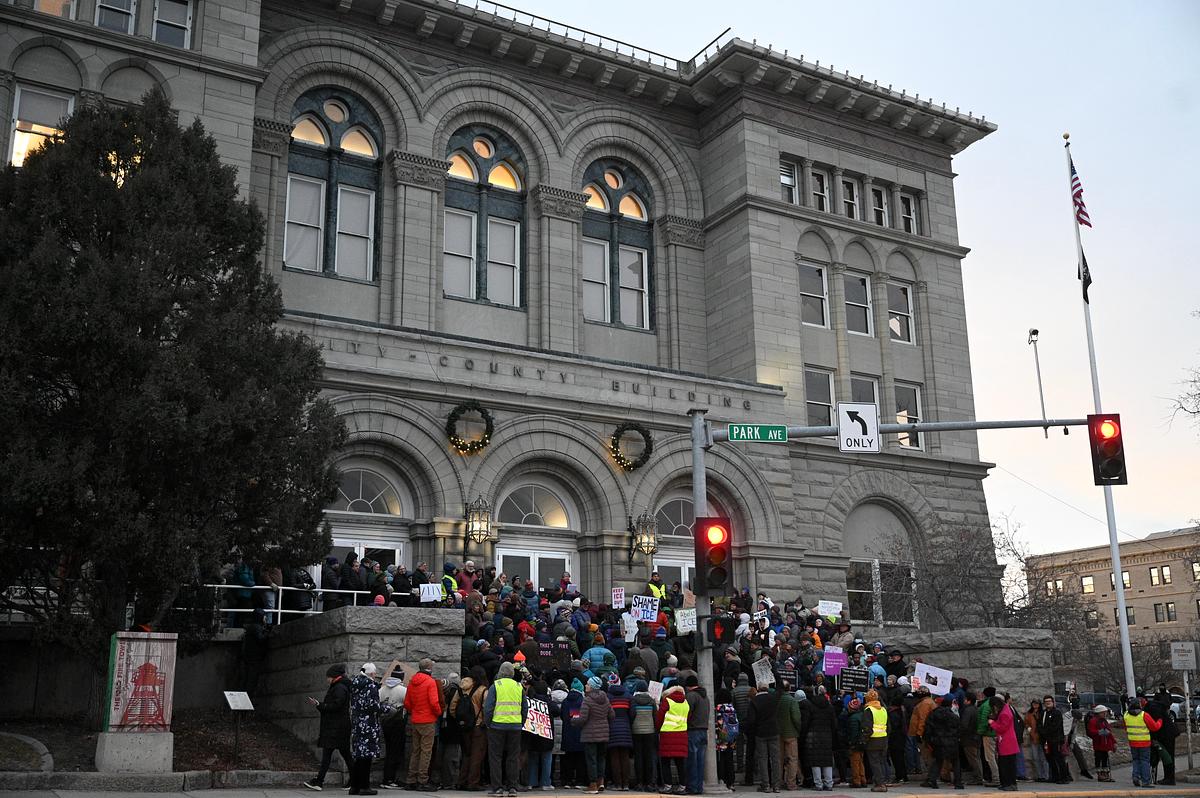
Helena commission votes to restrict local police work with ICE
After months of pressure from local immigration advocates and members of the public, and amid growing national frustration with immigration authorities, the Helena City Commission approved a resolution calling for its police officers to “avoid” assisting federal authorities with immigration enforcement.
The January resolution wasn’t Helena’s first directive to police about ICE interaction. A previous police policy instructed officers not to stop, investigate, detain or arrest anyone based on suspicion of violating federal immigration law.
Also in January, the Helena Police Department announced its withdrawal from the regional Missouri River Drug Task Force after the task force — which continues to include East Helena — decided to collaborate with U.S. Border Patrol agents.
Helena Police Chief Brett Petty said at the time, “ This is not to say that we will never be a part of MRDTF ever again, but I think the best way to do this right now is not enter into that agreement and bring a brief pause to it and see how this actually plays out here locally in Helena.”
The city of Helena’s public information officer, Amanda Opitz, issued a statement Wednesday afternoon saying the city is aware of the investigation announcement, but has not received official notice from the governor or attorney general’s office about the issue. The city says its resolution was legally vetted.
“The resolution was drafted with careful consideration of applicable local, state and federal law, and the City believes the resolution is consistent with those legal requirements,” the release states. “The City remains committed to upholding all applicable federal and state laws.”
Helena’s codification of immigration enforcement policy was kick-started after the detainment of city resident Christopher Martinez Marvan last summer. County law enforcement and HPD officers assisted federal agents with Marvan’s arrest.
Since then, community members and immigration advocates have organized, petitioned and rallied in protest of federal immigration presence in the city.
Knudsen said Helena is the only Montana city he is currently concerned with.
“To our knowledge, there’s not any other City Council in Montana who has formally taken action like this, formalized a policy statement,” Knudsen said. “There has been some concern about Missoula, but I’ve done some cursory investigation myself, and they haven’t adopted any kind of resolution or formalized policy as City Council. So at this point, we’re just looking at Helena.”
City of Missoula communications director Ginny Merriam told MTFP the city does not have a resolution on the topic and “has never been and [is] not now a sanctuary city.” The city has made its role in immigration enforcement “extremely clear” in recent weeks, including a post on the home page of its website, Merriam said. Mayor Andrea Davis and Police Chief Michael Colyer outlined the city’s approach during a Missoula City Council meeting Jan. 26, stating that city police do not ask for proof of immigration status when interacting with the public and do not have a role in enforcing immigration status.
Thousands of Montanans have engaged in public protests after federal agents killed U.S. citizens Renee Good and Alex Pretti during January encounters with ICE in Minneapolis. Businesses across Montana have also closed shop for days of protest. In Billings, Great Falls and Missoula, members of the public have asked cities to set policies about working with federal agents on immigration matters. The state law cited by Knudsen Wednesday prohibits state and local governments from adopting policies that restrict sharing or maintaining information about a person’s citizenship or immigration status. The law states that governments must comply with lawful requests from the Department of Homeland Security, and must honor lawful immigration detention requests.
The law carries a $10,000 penalty against cities for every five days of noncompliance. Knudsen said Helena’s penalty would amount to $30,000 as of Wednesday. The law also says local governments can be denied state grants and lose priority status for state-funded infrastructure projects for noncompliance. Knudsen specifically named project funding from the Montana Coal Board as support that Helena could be denied. The law allows for a waiver of all penalties if a local government complies with the law at least 14 days after the attorney general files a civil action against the community.
“The same section of state law empowers my office to file a civil action in Lewis and Clark County District Court, which I suspect we will end up doing,” Knudsen said.
JoVonne Wagner and Katie Fairbanks contributed reporting.
This story was updated Feb. 11, 2026, to include comment from the city of Helena.
LATEST STORIES
Gianforte extends deadline for landlords to avoid second-home tax
Gov. Greg Gianforte that a “technical glitch” has spurred the state to extend an application deadline that thousands of Montana landlords need to meet in order to avoid the state’s new second-home tax. The deadline, which had been set for March 1, has now been pushed back to midnight on March 20.
Montana ranks 7th for U.S. Olympians per capita
Montana ranks seventh in the nation for the number of Olympic athletes by birthplace on a per-capita basis since 1924, placing the state behind Alaska and New Hampshire and ahead of New York and Rhode Island.
BLM nominee talks land sales, local management in Senate confirmation hearing
Steve Pearce, a New Mexico Republican who appeared before the Senate Energy and Natural Resources Committee on Feb. 25, 2026, has come under fire from conservation groups for formerly calling for the sale of federal land to reduce the federal deficit.