

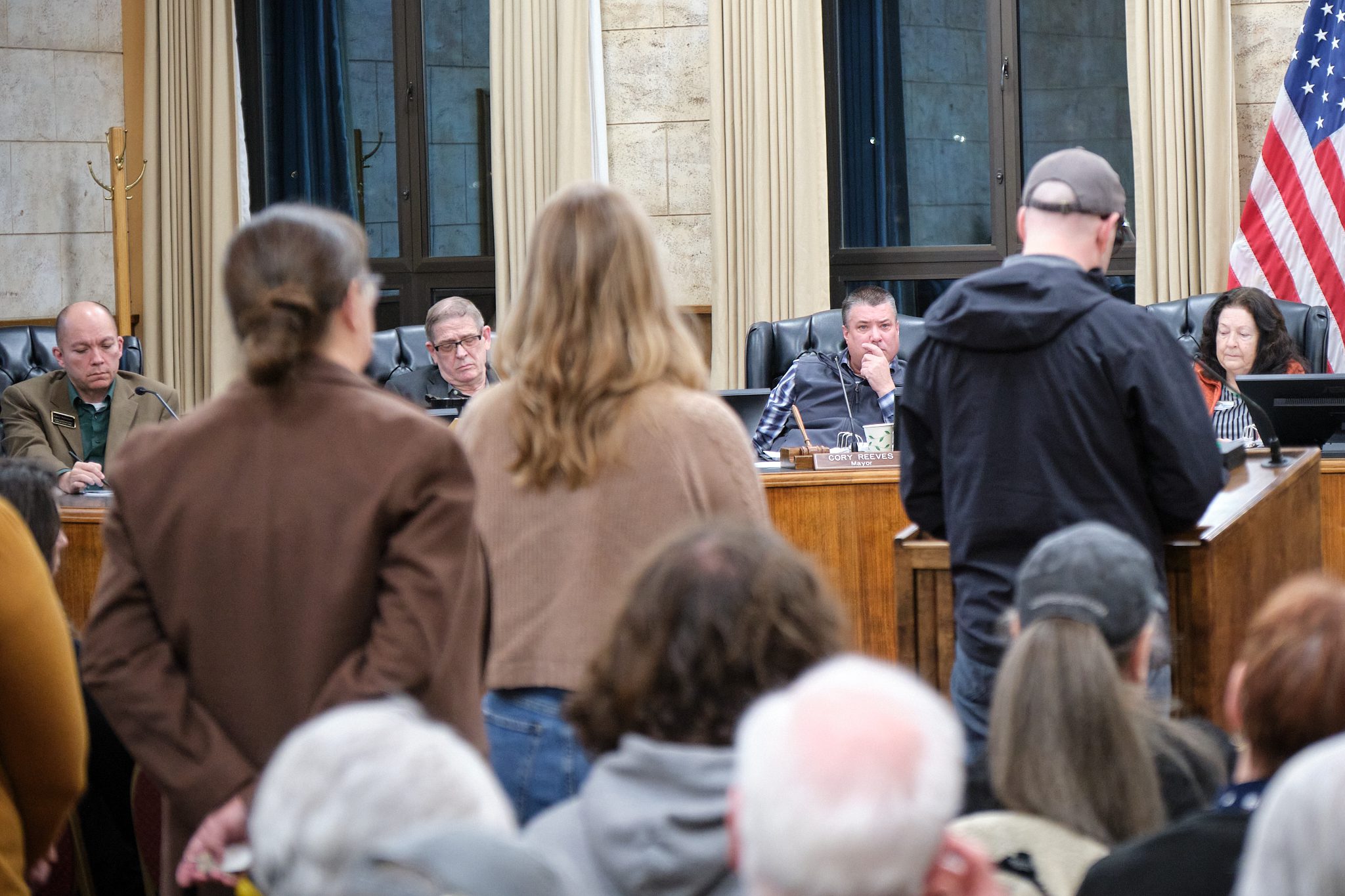
Community members urged Great Falls officials to take action in response to federal immigration enforcement during a Tuesday evening meeting of the city commission, which has not indicated any plans to take up the topic.
Most of the commenters expressed concern about the tactics of federal authorities, particularly in Minnesota, where agents shot and killed two residents during demonstrations.
“What we are seeing both nationally and right here at home is a system that fails to protect people from real harm while aggressively punishing people who pose no threat at all,” said Valynda Holland of Great Falls.
Others called on city leaders to take steps that would restrict local authorities from assisting federal immigration enforcement or from entering into formal agreements with those agencies.
Marci Wolff, another Great Falls resident who said she was a veteran and identified as a person of color, spoke about the fear that nonwhite people have experienced, no matter their documentation status. Numerous reports have documented federal agents detaining U.S. citizens during public demonstrations and in raids of private homes.
“I hope that this city would protect me and everybody, no matter what race you are,” Wolff said.
Many commenters referred to a resolution passed by the Helena City Council, which last week approved a measure saying the city would not enter into any formal agreement with the U.S. Department of Homeland Security. Those agreements, known as 287(g), are currently in place between federal agencies and the Montana Department of Justice, as well as sheriff’s offices in Flathead, Gallatin and Garfield counties. They allow local authorities to conduct or assist with limited immigration enforcement.
The Helena resolution also affirmed that local police wouldn’t stop someone based on their suspected immigration status and that the city wouldn’t disclose a person’s place of birth unless required by a court order. Missoula officials are reportedly considering a similar resolution.
While most speakers decried current immigration actions, some community members approached the podium Tuesday in support of federal enforcement.
“The people we are talking about with this are people who broke the law when they crossed the border,” said Rose Stone of Great Falls. “That’s a law. People who are concerned about ICE, just stay out of their way.”
The stream of public comments was orderly, though some anticipated a disruptive atmosphere after a social media dust-up in the days before the meeting. On Jan. 31, Great Falls Mayor Cory Reeves posted on Facebook after he learned that a group was preparing to comment on immigration enforcement at the upcoming meeting.
“The commission has zero control over federal immigration enforcement or incidents that happen in other cities or states. We cannot direct, influence, or change those actions,” Reeves’ post said in part. “Public comment at commission meetings is not a free-for-all to hijack a meeting for unrelated political protests.”
The preemptive reprimand about how residents could comment at a public meeting drew a social media rebuke from another commissioner, Casey Schreiner.
“In America you get to tell your government your thoughts, ideas, and concerns,” Schreiner posted on Feb. 1. “I support everyone’s right to come to the city commission and speak your mind regarding our local government’s current or potential future actions.”
Mayor Reeves’ Facebook post included a screenshot of an email sent by Gerry Jennings, a longtime local activist. Jennings sent an email to friends and supporters urging them to “express their displeasure” with federal enforcement. The screenshot posted by Reeves included Jennings’ personal phone number.
Jennings was among the speakers at Tuesday’s commission meeting. She said it’s within the city’s jurisdiction to outline how it might or might not participate in federal enforcement. She also spoke briefly about her phone number being publicly posted by the mayor.
“That is available for anyone to see and anyone to use,” Jennings said. “Is this legal? I can’t answer that question. Is this ethical? Absolutely not.”
Local jurisdictions, like cities and states, have grappled with their roles of authority as the Trump administration has pursued aggressive immigration enforcement priorities. This has been acutely felt in Minneapolis, where local authorities are pushing for involvement in investigations over the killings of Renee Good and Alex Pretti and looking to maintain public safety amid the turmoil.
Local legislative bodies have reacted in many ways, from an immigrants’ rights resolution in Edmonds, Washington, to an official statement of solidarity with Minneapolis approved in Prairie Village, Kansas.
In Minnesota on Tuesday, the Minneapolis City Council delayed decisions to renew liquor licenses for hotels that have hosted federal immigration authorities.
While immigration enforcement in Montana is different from the acute surges taking place in Minnesota, local law enforcement in this state has been involved in numerous federal arrests. The 2025 arrest of Beker Rengifo Del Castillo started with a traffic stop by Whitefish police. The town’s police chief said last year that U.S. Customs and Border Protection arrived after local officers reported the stop to dispatch. The man sued the police department over alleged racial profiling.
Helena officers were involved in the high-profile arrest of Christopher Martinez Marvan, who was arrested and detained last summer. Martinez Marvan also sued and alleged that his initial traffic stop was based on racial profiling.
In Great Falls, law enforcement officials have said that involvement in immigration enforcement doesn’t happen often, but there are interactions. A year ago, authorities arrested Jose Duran Valdivias, a citizen of Mexico, after Great Falls police detectives took pictures of Duran Valdivias’ ID card during an investigation and shared information with a Homeland Security agent. He pleaded guilty to illegal reentry and was placed in ICE custody last summer.
The Cascade County Detention Center is a regional holding center for immigration detainees through a contract with the federal government. The number of detainees can vary and is typically a dozen or fewer. On Wednesday, the jail roster included five people labeled as “immigration inmate.”
Local law enforcement interactions with immigration authorities are much more common in Hi-Line communities, where Border Patrol agents are more active along the Canadian border. If those arrests lead to criminal charges, many of the cases are heard at the U.S. District Court in Great Falls.
One case moving through that courthouse is that of Roberto Orozco-Ramirez, a Froid father who ran an automotive shop for years and was arrested last month. Court documents indicate that federal authorities, not local law enforcement, initiated that arrest, though the case spurred the Roosevelt County sheriff to post on Facebook that Orozco-Ramirez posed no danger to the community.
Court records for multiple cases describe arrests initiated through interactions with the Toole County Sheriff’s Office, the Havre Police Department, the Cut Bank Police Department and the Rocky Boy Police Department, among others.
This story was updated on Feb. 9, 2026, to attribute a quote to Rose Stone. The original version of this story mistakenly attributed the quote to another person.

In-depth, independent reporting on the stories impacting your community from reporters who know your town.
LATEST STORIES
How Trump tariffs jolted Montana coffee roasters
The first year of President Donald Trump’s second term is giving Helena coffee roaster Steven Ladefoged the wrong kind of jitters.
Gianforte extends deadline for landlords to avoid second-home tax
Gov. Greg Gianforte that a “technical glitch” has spurred the state to extend an application deadline that thousands of Montana landlords need to meet in order to avoid the state’s new second-home tax. The deadline, which had been set for March 1, has now been pushed back to midnight on March 20.
Montana ranks 7th for U.S. Olympians per capita
Montana ranks seventh in the nation for the number of Olympic athletes by birthplace on a per-capita basis since 1924, placing the state behind Alaska and New Hampshire and ahead of New York and Rhode Island.