

This piece is part of MTFP’s 2026 poll week, where we’re exploring data on how Montana voters feel about their elected officials, environmental concerns, immigration enforcement and other issues.
Montana voters’ generations-long aversion to a state sales tax is alive and well, according to a poll conducted by Montana Free Press and the Eagleton Institute of Politics at Rutgers University.
Despite support in recent years from business groups that argue the state’s tax structure should adapt to an increasingly tourism-focused economy, a majority of voters polled in late December and early January said they would prefer to keep the state one of the few in nation without a sales tax — even if the revenues are used to reduce property tax bills.
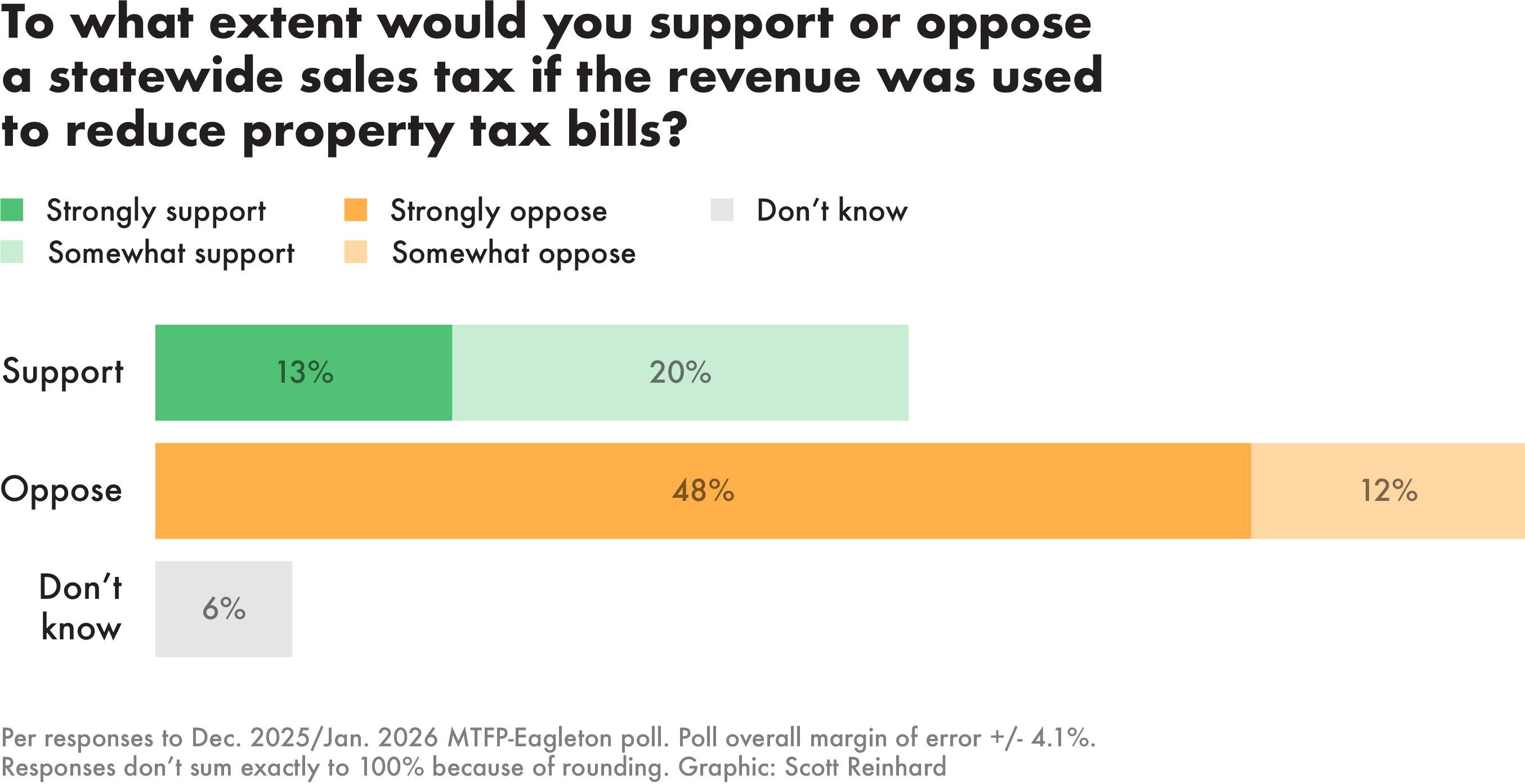
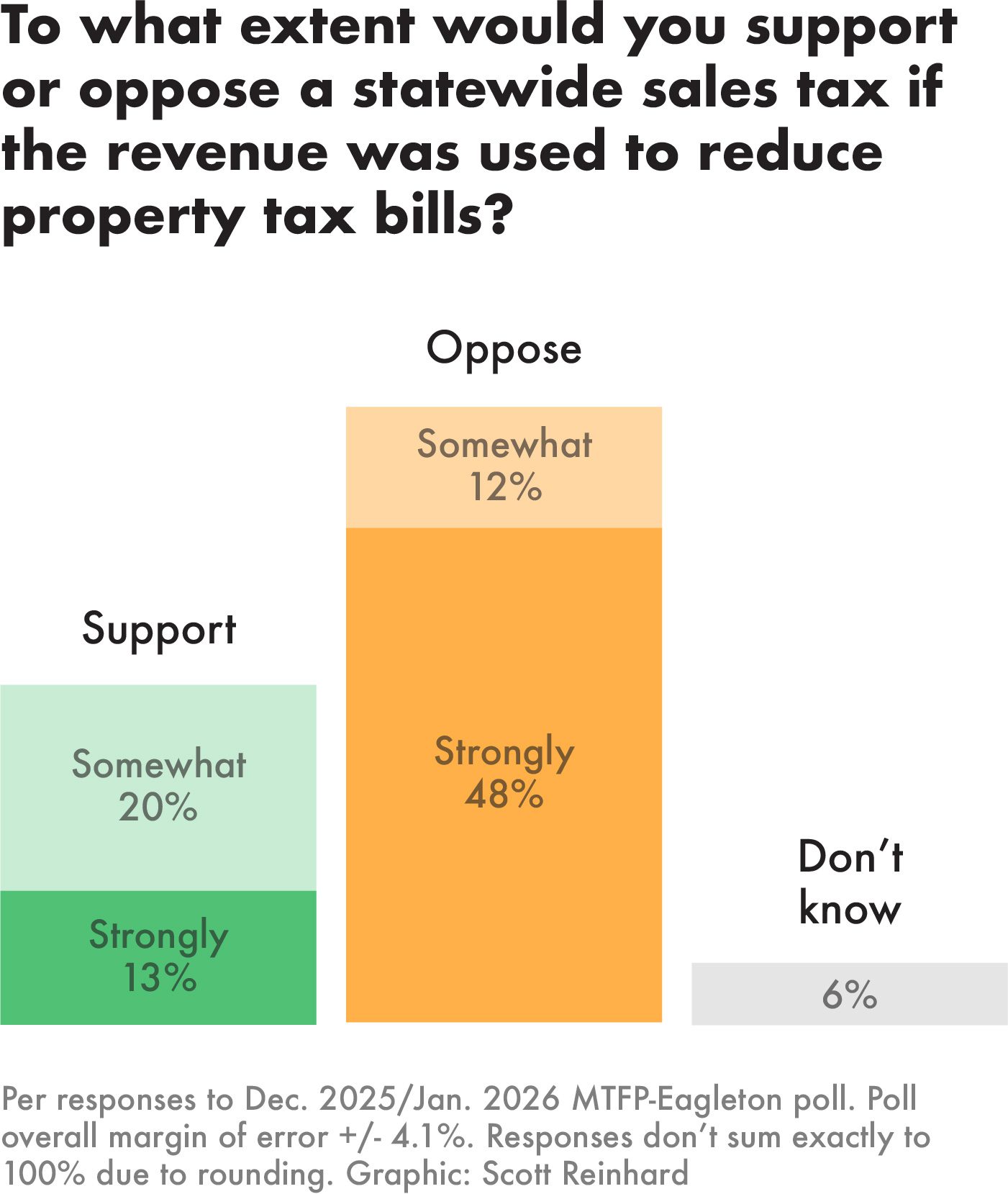
In the poll, 48% of respondents indicated that they “strongly” oppose a statewide sales tax “if the revenue was used to reduce property tax bills,” with another 12% saying they are “somewhat” opposed. In contrast, only 33% indicated strong or lukewarm support, putting the idea underwater by 27 percentage points.
That opposition held up across party lines. Only 34% of Republicans, 38% of Democrats and 32% of independents voiced support for a sales tax.
Montana is currently one of five states without a sales tax. Instead, the state’s current tax system relies heavily on income and property taxes, which are the primary revenue streams for state and local government, respectively. Historically, property tax revenues were anchored by payments from large industrial properties such as mines and timber mills, many of which have closed or scaled back their operations over the past several decades. That means the cost of paying for local services such as schools and law enforcement has to fall elsewhere.
In a series of presentations last summer, Montana Chamber of Commerce President and CEO Todd O’Hair contended that the long-term decline of property-intensive mining and timber industries has undermined the foundation of that tax system. O’Hair, who represents the state’s largest business lobbying group, said he believes it’s time for Montana to consider other options for the revenues necessary to fund public services without placing undue burden on homeowners and businesses.
Meanwhile, opponents of a sales tax argue that shifting to a general sales tax model would result in a heavier tax bill for lower- and moderate-income families.
Montana voters have historically voted down sales tax measures by large margins, defeating referendums in 1971 and 1993 — with the latter failing by 49 percentage points. Voters also passed a constitutional amendment in 1994 that caps any future state sales tax at 4% unless that state constitution is amended again.
As such, while some Montana resort communities levy sales taxes as local-option taxes, the state remains one of five in the country without a statewide sales tax.
The MTFP-Eagleton poll surveyed 801 registered voters through telephone interviews and text-to-web questionnaires. Data was collected from Dec. 23, 2025 to Jan. 3, 2026. The poll, which was weighted to reflect the state’s electorate, has an overall margin of error of plus or minus 4.1 percentage points.
This piece is part of the Montana Insights project, which commissioned a poll to help MTFP readers understand public sentiment on key Montana policy issues.
OTHER POLL STORIES
75% of voters want Montana to have at least as much federal land as it does now
Federal land transfer has been a party of the GOP party platform at both the state and national level, but a recent MTFP-Eagleton poll indicates that a majority of Republican voters oppose reducing the amount of land in federal ownership.
Montanans want more solar, natural gas development, are less interested in new coal plants
The poll results on Montana’s energy mix come as politicians and policymakers grapple with surging electricity demand spurred by investment in artificial intelligence and the data centers that support it.
Poll week: How Montanans feel about sales tax, immigration and state officials
We polled Montana voters on an array of issues. Results will roll out the week of March 2.