


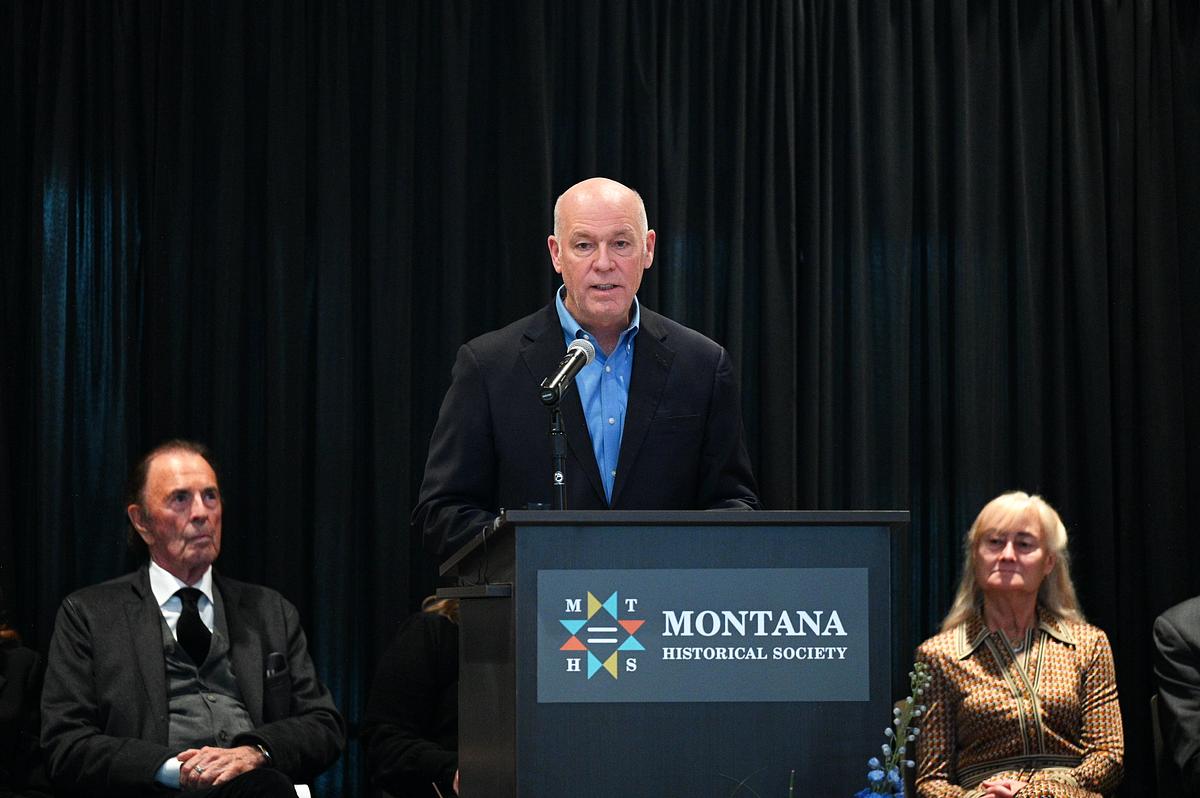
Gov. Greg Gianforte has claimed a homestead tax exemption on his longtime house on the outskirts of Bozeman, a designation that requires the property be occupied as a “principal residence” under a tax law the governor signed earlier this year. That’s despite a constitutional requirement that the Montana governor “reside” at the state’s seat of government in Helena.
Asked Thursday about that apparent contradiction, the governor’s office pointed to a pending Department of Revenue rule that makes an exception to the occupancy requirement for residents who are absent from their home for “work assignments.” MTFP learned about the homestead exemption, which wasn’t previously reported by media outlets, Thursday using an online lookup tool published by the revenue department.
“Governor Gianforte and the First Lady reside in their private Helena residence, and also spend time at their home of more than 25 years in Bozeman,” Gianforte Press Secretary Kaitlin Price said in a statement to MTFP. “As with any Montanans claiming the homestead reduced tax rate, the governor has attested that he owns and lives in his Bozeman home for at least 7 months of the year.”
The 1972 Montana Constitution requires that the governor and other executive branch officials — the lieutenant governor, secretary of state, attorney general, superintendent of public instruction and state auditor — each “reside at the seat of government,” which is defined as “in Helena” except “during periods of emergency resulting from disasters or enemy attack.”
Gianforte’s decision to split his time between Helena and Bozeman, where he built a successful technology company before entering politics, has drawn occasional scrutiny from Democrats. As he was seeking re-election in 2024, for example, the Montana Democratic Party attacked him for voting as a Gallatin County resident, listing a Bozeman address on hunting licenses, and claiming a property tax rebate on the Bozeman home.
That Democratic attack cited reporting by the Daily Montanan, which quoted several neighbors around what was then Gianforte’s main Helena residence saying they typically saw him there only on Mondays and Tuesdays.
Residency questions have come up occasionally with Montana elected officials in recent years, but not in ways that have necessarily produced clear legal guidance on how much time in Helena the constitutional residency requirement requires.
Former Secretary of State Corey Stapleton, for example, was dinged by auditors in 2019 for putting more than 27,000 miles on a state vehicle to travel between Helena and Billings, where he had established his family home as a telework location. Additionally, in 2023, a legal challenge brought by a local newspaper publisher produced a series of court rulings that voided the 2022 election for Roosevelt County Attorney on the basis that the winning candidate, who had run unopposed, didn’t maintain a home in the county.
The homestead exemption is a component of the second-home tax policy passed by the state Legislature and signed into law by Gianforte, a Republican, earlier this year in an effort to lower taxes on comparatively modest homes being used as long-term rentals and owner-occupied residences.
The new tax approach functions by raising the state’s default residential tax rates, then offering a discount to properties that qualify for the exemption as owner-occupied “homesteads” or long-term rental properties.
Most of the state’s homeowners were automatically qualified for a homestead exemption on their primary residence after receiving this year’s round of property tax rebates — which were technically available only to homes used as principal residences for at least seven months in 2024. Others have been able to qualify via an application that requires making a similar attestation. (That application and a similar one for long-term rental landlords are open through March 1, 2026.)
The rules cited by the governor’s office are part of a broader package prepared by the revenue department to clarify various administrative details about the second-home tax that weren’t specified in the new law.
The specific provision reads as follows:
“Temporary absences that affect occupancy of a principal residence such as admission to a hospital, nursing home, or similar facility for short-term medical or non-medical reasons, military deployments, or work assignments, do not change an owner’s principal residence for purposes of the homestead rate.”
Gianforte, who took office in early 2021, concludes his second and final term as governor at the end of 2028.
Public records including a 2025 tax bill indicate that the Bozeman-area property, off Manley Road, is owned through a family trust in the name of Gianforte and his wife, Susan.
As MTFP has reported previously, the land under the Manley Road home and surrounding parcels also owned by the Gianfortes are classified as agricultural property, which qualifies them for highly favorable tax treatment under longtime provisions of the state’s property tax code. As such, the homestead exemption will apply only to the home structure, valued separately from the underlying land at $1.5 million by the Montana Department of Revenue.
According to MTFP calculations, the home structure’s taxable value would be about 39% higher next year without the homestead exemption. At the level of taxation applied to the property by local governments this year, that translates into about $2,600 in savings.
The governor owns at least three other Montana properties, including the historic Hauser Mansion in Helena, which the Gianfortes purchased in early 2024 with the intent to ultimately donate it to the state. At the time, the governor said in a statement that his family had purchased the nine-bedroom 1885 mansion for $4 million “to call our home here in Helena.”

Property records indicate that a limited liability company associated with the Gianfortes still owns another $1.3 million home in Helena’s mansion district that they occupied earlier in his term as an alternative to the state’s official-but-long-neglected governor’s residence a few blocks east of the state Capitol.
The Gianfortes also own a fourth residence on Georgetown Lake between Philipsburg and Anaconda. It is valued by the state at approximately $4 million.
The revenue department’s lookup tool indicates that none of the three non-Bozeman properties owned by the Gianfortes have been qualified for a homestead exemption, meaning they’ll presumably pay taxes on those properties under the higher second-home tax rates next year.
latest stories
2026 election slates up and running
One week into the filing period for the 2026 elections, one thing is clear: The biggest primary race, to be decided in June, will be the Democratic contest for Montana’s Western U.S. House District. Four candidates are already vying for the Democratic nomination to face incumbent Republican Rep. Ryan Zinke.
EPA finalizes repeal of emissions rule that could have forced Colstrip’s closure
The U.S. Environmental Protection Act’s announcement comes amid a suite of changes the agency has adopted to reverse former President Joe Biden’s climate and public health initiatives.
State business leaders react as Supreme Court nixes many Trump tariffs
As the U.S. Supreme Court declared many of President Donald Trump’s import tariffs unconstitutional Feb. 20, state business leaders reached by Montana Free Press were split on whether the ruling will make life easier for Montana businesses that have struggled to navigate the president’s often-volatile trade policies.