

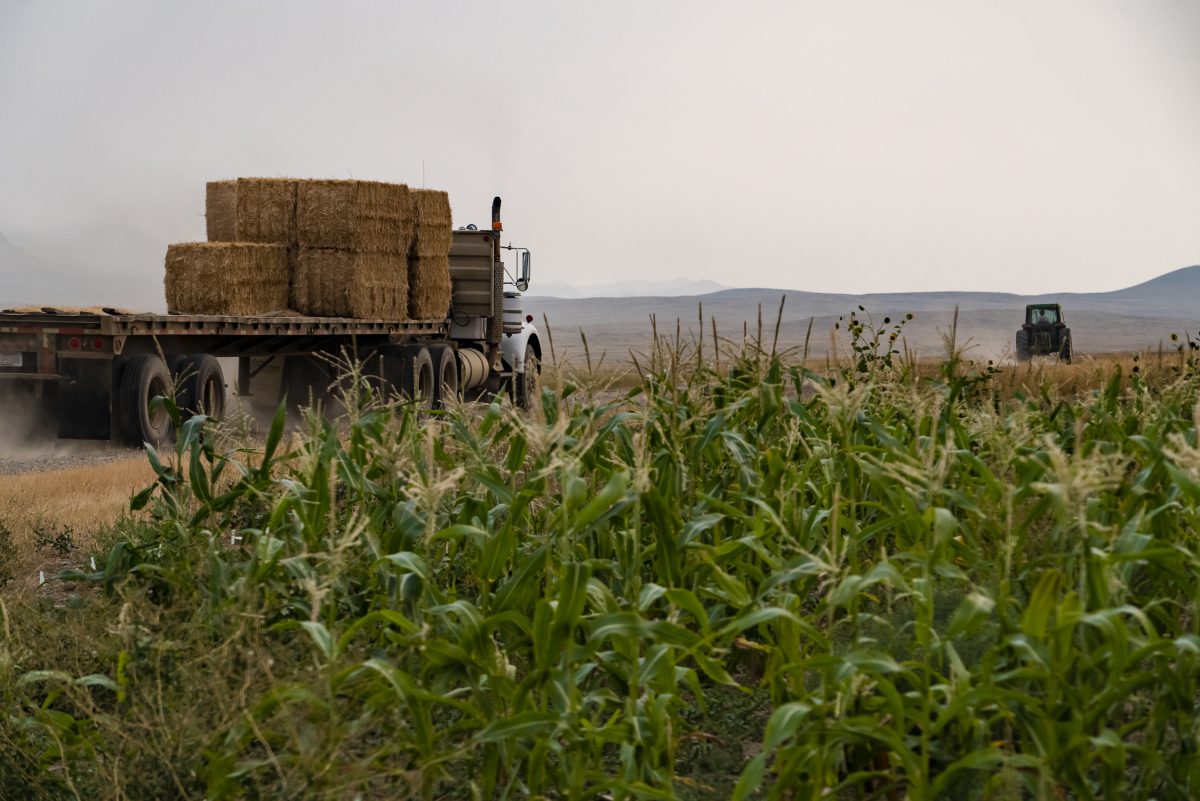
Representatives of Montana’s farming sector had mixed reactions Monday after President Donald Trump unveiled a $12 billion farm-aid package aimed at helping U.S. producers — particularly those hit hard by the tariffs, falling crop prices and uncertainty about foreign markets.
Details remain scarce on how the funds will be distributed, but in a press release the administration framed the package as relief for farmers hit by “market disruptions, elevated input costs, persistent inflation and losses from unfair trade practices.” Several national agricultural interest groups note that many of those pressures stem directly from the administration’s own trade policies: aggressive tariffs and escalating trade tensions that have helped drive down demand for American products, especially from major buyers such as China.
In an interview Monday with Montana Free Press, Nicole Rolf, senior director of governmental affairs at the Montana Farm Bureau Federation, expressed optimism about Trump’s announcement.
“We’ve been asking for help for farmers to get through to next year. Twelve billion dollars will help them get through,” Rolf said, until government payouts to farmers included in the One Big Beautiful Bill Act passed earlier this year kick in. Rolf also said she was pleased that “all of Montana’s major [crops],” which include wheat, barley and lentils, were included in the program.
Walter Schweitzer, president of the Montana Farmers Union, was less enthusiastic. He said farmers’ problems “today are almost wholly caused by tariffs,” citing both the affordability of inputs like fertilizer and the loss of markets to sell what farmers grow. He said the proposed $12 billion package did not do enough to address the damage he tied to the president’s trade policies.
“This ‘bridge’ gets us to the middle of the river. We not only need to build a bridge across the river, but we need to build a road beyond,” Schweitzer said Monday. “We’re going to have to spend a lot of money to incentivize customers to come back to us when this is all over.”
According to a recent analysis by the Center for Strategic and International Studies, U.S. agricultural exports to China have dropped by more $6.8 billion since January — a decline of 73%. That trend reflects a sharp decline in demand for commodities, most notably soybeans. According to the same CSIS analysis, in the first two quarters of 2025, Montana experienced a much lower drop in exports to China, around 19%, than nearby North Dakota, which saw its exports to the third-largest market for U.S. agricultural products plunge by 85%.
LATEST STORIES
75% of voters want Montana to have at least as much federal land as it does now
Federal land transfer has been a party of the GOP party platform at both the state and national level, but a recent MTFP-Eagleton poll indicates that a majority of Republican voters oppose reducing the amount of land in federal ownership.
Secretary of State Christi Jacobsen joins contest for Zinke’s western U.S. House District seat
Jacobsen made her announcement on Facebook with a campaign video portraying her as both a political outsider and the favorite of Donald Trump.
Montanans want more solar, natural gas development, are less interested in new coal plants
The poll results on Montana’s energy mix come as politicians and policymakers grapple with surging electricity demand spurred by investment in artificial intelligence and the data centers that support it.