


The MT Lowdown is a weekly digest that showcases a more personal side of Montana Free Press’ high-quality reporting while keeping you up to speed on the biggest news impacting Montanans. Want to see the MT Lowdown in your inbox every Friday? Sign up here.
When partisan battles in Congress drove the federal government to shut down Oct. 1, I began doing pulse checks on some of the many Montana health and human services programs that rely on federal money.
First up: The Supplemental Nutrition Assistance Program, or SNAP, which provides food benefits every month for more than 70,000 low-income Montanans. Then WIC, the Women, Infants and Children food program, specifically for pregnant women and the parents and caregivers of young children. My mind also went to another acronym: TANF, the Temporary Assistance for Needy Families program, an emergency cash assistance program.
The state health department told me at the start of the shutdown that it had money to continue the programs for “at least 30 days.” But beyond that, who knows?
For at least one program, that 30-day funding cliff is fast approaching. Earlier this week, DPHHS announced that SNAP benefits would not be distributed in November, a gut-punch to the thousands of families who rely on the program to help stretch their grocery budgets.
Other federally funded safety net programs have a somewhat longer lifeline. In a mid-October newsletter, staff for Montana’s WIC program said that the program was using “carryover” funds from previous budgets to ensure that benefits remained active through at least Nov. 30, “as we await further guidance from our federal partners.”
The department has not made any specific references to how TANF distributions will be impacted by the federal shutdown. That program’s pot of unspent money, at least, has grown in Montana as fewer people qualify for the benefits by living in deep poverty, keeping it insulated from the pause in ongoing federal contributions during the shutdown.
But as congressional gridlock persists, other programs that weren’t on my original list are beginning to feel the squeeze.
Across the country, many organizations that provide Head Start programs, the antipoverty child care initiative launched by President Lyndon B. Johnson in the 1960s, are staring down a Nov. 1 funding cliff. That’s when about 10% of Head Start programs across the country plan on restarting annual grant contracts with the federal government — that is, if the federal government is functioning enough to award new contracts.
Only one of the 22 Head Start programs in Montana has a grant renewal date that falls on Nov. 1. The Fort Belknap Head Start network in the Hi-Line towns of Harlem, Hays and Lodge Pole serves about 125 infants and young children and employs more than 50 staff members.
Julia Doney, the program’s director, said Wednesday that the Fort Belknap tribal government has agreed to cover the cost of November staffing and supplies if the federal government doesn’t restart in time. But one month of those expenses could be as much as $200,000, Doney estimated, and she has no guarantee that her next Head Start grant will be backdated to Nov. 1.
“If we don’t get refunded, the tribe will be out that money,” Doney said.
Doney said the families that rely on her child care programs have a keen sense of how essential the services are. One of the Head Start buildings has to temporarily close this month for mold mitigation, she said, another strain on the program’s budget and added stress on families who have no other child care options.
Doney, who has worked for the program since 1974 and once relied on Head Start for her own daughter’s child care, said it’s been hard telling families she can’t help them, even for a few days. But some things, whether mold or congressional politics, are outside Doney’s control.
“To try to make the parents understand that, who need the services so bad, it’s not something they should have to deal with,” Doney said.
She said she’s tried to register her concerns with Head Start staff in Washington, D.C., but, given the shutdown, no one has responded to her messages. Doney said she’s buying herself a plane ticket to fly to the nation’s capital to find someone — a politician or federal worker — whose door she can knock on.
“It’s shameful,” Doney said, about the political conflict that has put child care and food assistance programs at risk. “Adults are playing with children’s lives. That’s the bottom line. And each party thinks that they’re right. But they’re wrong.”
— Mara Silvers
By the Numbers 🔢
The number of positions the U.S. Department of the Interior identified for elimination amid the Trump administration’s ongoing push to reduce the federal government’s payroll.
The figure surfaced in a filing the Interior Department submitted to a federal court in northern California Oct. 17. The judge overseeing that case is weighing in on whether the Trump administration can lay off unionized federal employees while the U.S. government is shut down.
The 2,050 employee figure includes employees working for Interior Department agencies, such as the Bureau of Land Management, the National Park Service, the U.S. Fish and Wildlife Service, the U.S. Geological Survey and the Bureau of Reclamation.
The breakdown of positions eyed for elimination — and blocked, at least temporarily, by a temporary restraining order U.S. District Court Judge Susan Illston issued Oct. 15 — paints a broad-brush picture of the department’s reduction-in-force, or RIF, plans. Thus, it’s hard to say precisely how many federal positions in Montana the Interior Department was set on “imminently abolishing” before the temporary restraining order went into effect.
But there are some clues in the filing about Montana-based employees who could be facing position removal:
- 57 positions working within the Pacific West Regional Office of the National Park Service, which includes all or parts of eight states. The Big Hole National Battlefield in southwest Montana is under that regional umbrella.
- Two Montana-based employees of the Bureau of Reclamation, which oversees federally owned and managed dams and water projects such as the Milk River Project.
There could be other Montanans working at regionally dispersed offices whose positions are on the chopping block. The Migratory Bird Program, which is facing a 35-position reduction, includes employees based all over the United States, as does the Office of Conservation Investment, which works for the U.S. Fish and Wildlife Service on habitat conservation and improvement. It’s facing a 14-position reduction. The USGS-administered Climate Adaptation Science Centers could potentially lose University of Montana-based employees. The filing itself doesn’t provide that level of detail, but the odds aren’t in the employees’ favor: More than half of the program’s 75 positions were slated for removal.
Although Illston’s order has temporarily stalled this piece of the federal workforce reduction, more RIFs are planned. During an Oct. 15 appearance on The Charlie Kirk Show, Office of Management and Budget Director Russell Vought said the administration is working to cut more than 10,000 positions during the shutdown to “be very aggressive” in “shuttering the bureaucracy, not just the funding.”
—Amanda Eggert
The Gist 📌
This fall’s municipal elections will give Montana voters their first encounter with a new requirement to provide their birth year on the back of mail-in ballot envelopes alongside the previously required signature line. The change is a result of a legislative mandate aimed at enhancing mail election security that took effect Oct. 1.
Election officials in Montana’s two largest counties, Yellowstone and Missoula, said this week that the change had already forced them to reject hundreds of ballots in early returns — 411 as of Thursday, according to Missoula County Election Administrator Bradley Seaman, and about 440 as of Wednesday, according to Yellowstone County Election Administrator Dayna Causby.
“It’s a pretty substantial jump,” said Seaman, whose office issued a press release on the issue Oct. 21. He said that the 411 figure compares to 127 ballots rejected for other reasons, such as missing or invalid signatures. As of Oct. 23, Missoula County had about 14,000 ballots returned out of approximately 77,000 mailed to voters, Seaman said (in addition to city elections, this year’s Missoula ballot includes a county infrastructure levy).
As they have done for years with the signature field, election workers set aside ballots with a missing or invalid year of birth and try to reach the corresponding voter to give them the chance to remedy the error. Officials in several counties said voters are typically notified about rejected ballots with a mailed notice and a phone call or email when possible.
Cascade County Election Administrator Terry Thompson said that her office, which mailed out ballots a few days later than some other jurisdictions this year, had only received a few hundred ballots back as of Oct. 23. Of those, only a handful are missing the year of birth so far, she said.
In Helena, Lewis and Clark County Elections Supervisor Connor Fitzpatrick said that his jurisdiction is in a somewhat different position than Missoula or Yellowstone counties, with only 15 returned ballots missing their signatures as of Oct. 23.
He noted that, unlike most other jurisdictions, his office was able to do a “soft launch” of the year-of-birth requirement with the Sept. 9 city primary and school bond election, including a year-of-birth field on ballot envelopes without rejecting ballots that missed it because the new law had not yet taken effect. Lewis and Clark County also sent out a mailed message explaining the change, he added.
“I think that direct mailer has really been our saving grace here,” Fitzpatrick said.
In Missoula County, Seaman said that printing and sending a mailer would probably have cost the county between $8,000 and $10,000. He also noted that his office has added extra shifts to its staffing roster this year in an effort to accommodate extra outreach to voters who are facing a potential ballot rejection.
“As these numbers go up, we’re working hard to make sure everyone gets both a letter and another contact,” Seaman said.
The new mandate, which passed as this year’s House Bill 719, is currently facing a legal challenge in federal district court but has not been blocked by a judicial order for this year’s elections.
Voters who want to check the status of their ballot can do so via the state’s voter portal page, voterportal.mt.gov.
—Eric Dietrich
Verbatim 💬
“This is really messing up my hunting season.”
— Part-time Whitefish resident Fred Ramsdell, reflecting on his changed schedule since finding out he won the 2025 Nobel Prize in Physiology or Medicine in early October.
Ramsdell made the crack about his now-limited days for hunting in an interview with the Flathead Beacon. Ramsdell won the award with co-laureates Mary E. Brunkow and Shimon Sakaguchi for their contributions to research about immunology and how the immune system is kept from attacking the body.
— Mara Silvers
Say Again? 🤔
The Montana Department of Environmental Quality discovered concerning levels of coliform bacteria in potable water at the state prison months before multiple leaks caused the Deer Lodge facility to cut off its water supply and initiate a broad renovation of the water system that serves about 1,500 male inmates.
Water quality tests measure total coliform, a catch-all comprising coliform bacteria from various sources that exist in almost all environments, according to DEQ’s interim Public Water Supply Bureau Chief Eugene Pizzini. Total coliform can be an indicator of contamination.
“Where we don’t see [total coliform] is in drinking water,” Pizzini said in an Oct. 21 interview with Montana Free Press. “And so when you see them in drinking water — it’s not that the total coliform themselves are pathogens or disease-causers — but because they’re there, there could be something else that got in with them.”
Water quality tests conducted as recently as Oct. 22 indicate the presence of coliform in Montana State Prison water, though it is not accompanied by Escherichia coli, also known as E. coli.
MSP first confirmed coliform in their water in July. E. coli was not present. MSP failed to perform its monthly water test in August. In September, prison water again showed the presence of total coliform and again, no E. coli alongside it.
Pizzini said the multiple positive samples collected in September led him to make the “general assumption” that the prison’s water system had leaks.
The prison discovered the presence of several leaks in early October and cut off running water. Inmates reported inhumane conditions in the week before water returned to some MSP units.
While work to renovate the water system is ongoing, running water will be temporarily unavailable in some prison units throughout the day. The upgrade could take two to three months. The Department of Corrections will consult DEQ during the renovations to ensure the new system produces safe drinking water, according to Pizzini.
The prison first confirmed coliform in its water supply during a routine test in July. This initiated what DEQ calls a “level one investigation” — the prison conducted an internal review of its water systems.
Because MSP failed to collect its routine sample in August, Pizzini said he couldn’t assume the water still had the bacteria.
“All I could do is issue them a violation for failure to monitor, as required,” Pizzini said.
In September, the water again tested positive for coliform. MSP then faced a “level two investigation,” this time requiring DEQ field analysts to visit the prison.
On Oct. 9, MSP staff accidentally cracked a 50-year-old piece of the water infrastructure during routine work on the water system, according to The Missoulian. The department has now started renovating the system’s entire water supply using money allocated for prison infrastructure improvements in House Bill 5 passed by the Legislature earlier this year.
According to Pizzini, Montana State Prison has not had dangerous levels of E. coli or nitrates in potable water over the last several decades.
— Zeke Lloyd
Viewshed 🌄
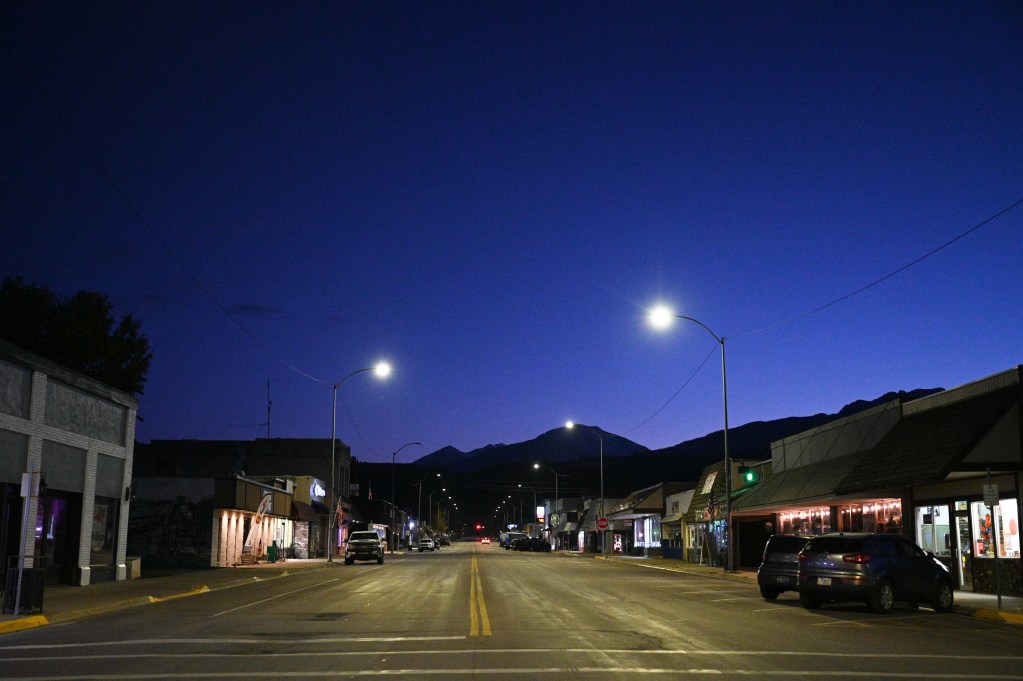
Lights inside businesses and homes around Libby illuminate the darkening sky Oct. 14, 2025. Last week, reporter Mara Silvers and I headed up to Libby in advance of the oral arguments in the federal appeal of Wells and Walder v. BNSF Railway — a case that could impact hundreds of pending asbestos lawsuits against the Texas-based railroad company.
— Lauren Miller
Highlights ☀️
In other news this week —
- Here’s why two Libby asbestos victims may never receive an $8 million judgment.
- The Montana Public Service Commission voted to remove its president from that position.
- About 77,000 Montanans could lose access to food assistance if the government shutdown continues.
- A Great Falls city commissioner candidate suggested using a congregated neighborhood for the unhoused as a tourist attraction.
On Our Radar
Nora — It’s fall, y’all! I made pumpkin cardamom muffins this week, and this recipe is a winner!
Holly — Growing up, I loved visiting the elephants at the Oregon Zoo (RIP Packy). And now, through the magic of the internet, I can listen to my kid squeal in delight watching this year’s Squishing Of The Squash, featuring the adorable Tula-Tu.
Zeke — It was a big week for elephants at zoos across the country. My hometown of Columbus, Ohio, welcomed a newborn elephant on Oct. 21. The calf’s half sister, Rita Jean, was born in July. This year marks the first in zoo history that two calves were born in the same year.
Eric — A new Montana law this year means every city and town in the state is now required to publish audio or video recordings of its meetings. This lovely piece from the Terry Tribune illustrates what that looks like in practice in a 562-person town in Eastern Montana.
Amanda — I was delighted to stumble across “A Surf Legend’s Long Ride,” a piece New Yorker writer William Finnegan wrote about a 75-year-old roofer from Hawaii who still makes regular forays into his local surf break. I’d wager that profiles are some of the hardest feature stories to write, but they can be oh-so-enjoyable to read, as Finnegan reminds us.
*Some stories may require a subscription. Subscribe!