

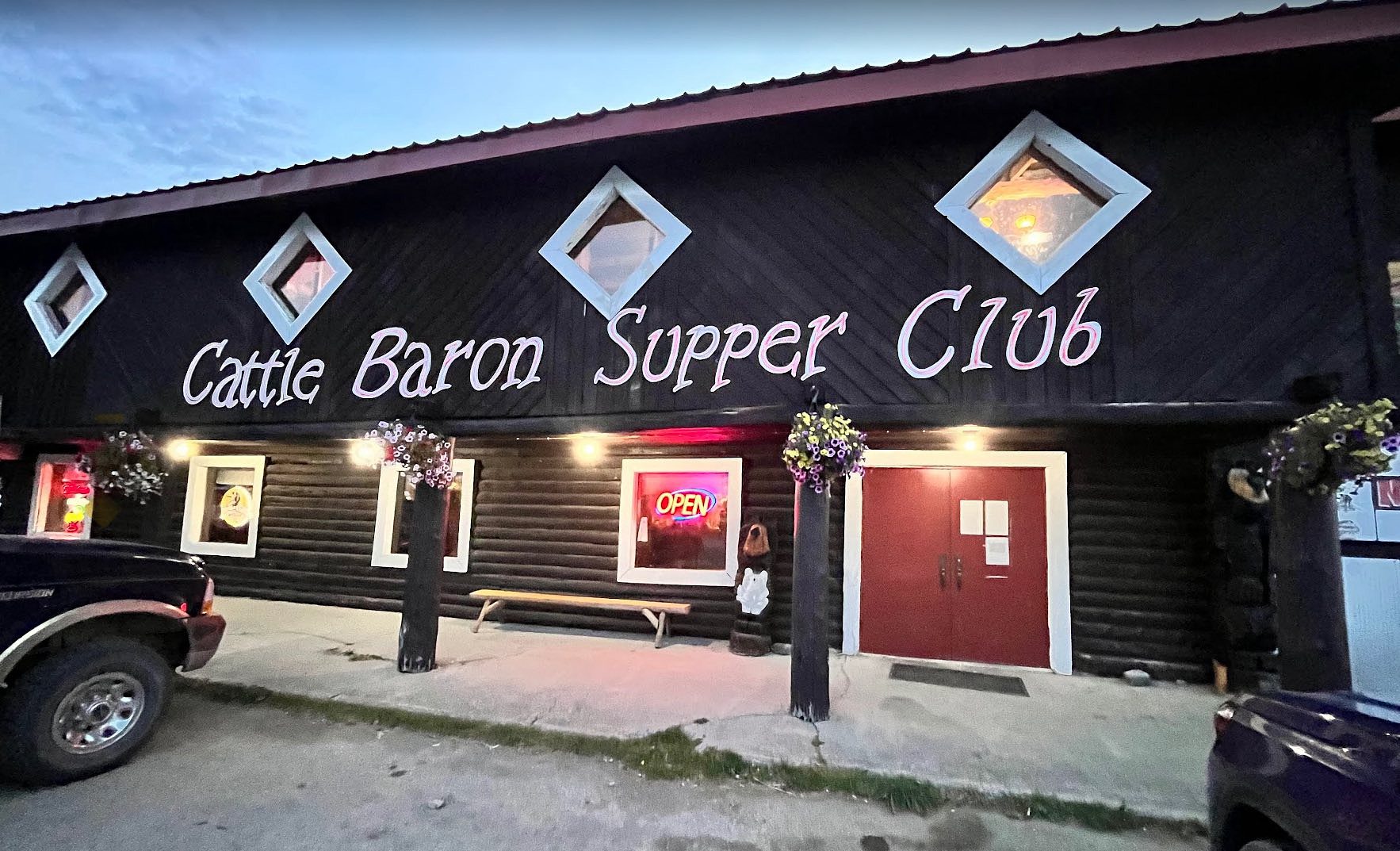
When Bob Burns got a call from a family member about a small electrical fire at the Cattle Baron Supper Club, his first thought was, “It can’t be anything major.”
The iconic restaurant and landmark in Babb had seemed indestructible, surviving freezing temperatures and hurricane-force winds. The 10,000 square foot building, made to look like a log cabin lodge, had been in his family for generations.
But Burns was stunned when he drove to the site on the evening of Jan. 14. He watched as blue flames licked the roof and thick black smoke billowed into the cold winter air.
Burns, 82, helped build expansions to the famous steakhouse years ago. His mind immediately went to the foam insulation spray he’d used in the early 1980s. The flammable foam acted like gasoline on the fire. He called his wife, Charlene Burns.
“It’s gone,” he told her, as the flames rose.
Charlene, 76, didn’t believe it. She raced to the site, but could see the flames from a mile away. She pulled over and took a photo of the orange sky behind the dreamcatcher hanging from her rearview mirror.
“All of our dreams went up in smoke,” she wrote on Facebook that night.
The Cattle Baron Supper Club was a hallmark of Babb, a tiny town home to about 130 people on the eastern edge of Glacier National Park on the Blackfeet Reservation. For community members, the Cattle Baron was the go-to spot for date night, anniversaries, celebrations and even weddings. For tourists visiting the park, the restaurant was known for its juicy steak, iconic bread and thoughtful display of Blackfeet culture.
The Cattle Baron employed hundreds of people — including at least 60 of Bob and Charlene’s grandchildren — in a place where there aren’t a lot of jobs. It was a community hub in a town without a community center, public park or even many sidewalks. It was a source of pride and a bastion of Blackfeet culture and identity.
After community members came together to clear the rubble, the Burns have vowed to rebuild.
“We’re going to take one more run at it,” Bob told Montana Free Press in a recent interview.
FROM ROUGH AND ROWDY TO FAMILY FRIENDLY
Before becoming the Cattle Baron, the building was the Babb Bar, a small, roadside establishment where fights frequently broke out and the regular crowd was known to be rough and rowdy. Burns bought that bar from his father in the 1970s.
“You can’t imagine how much fun it was,” he said. “It was nuts.”
He remembers telling a visiting reporter at the time that the bar wasn’t as rowdy as its reputation implied — only for a woman to ride inside on a horse, a man to drive in on a Harley and another customer to come in with a bear cub.
“Those are isolated incidents,” Bob jokingly said he told the reporter at the time.
In the 1980s — after he married Charlene and as he became more in touch with his Blackfeet culture — Bob built a large addition to the building. Soon after, the Babb Bar became the Cattle Baron Supper Club.
The Burns served grilled steaks, bread baked from Bob’s mom’s recipe, salad dressing made from Charlene’s mom’s recipe and a famous secret sauce, to which both Bob and Charlene contributed ingredients.
A pictograph timeline painted on the building’s interior walls depicted Blackfeet history. It started with the “dog days,” said Lockley Bremner, Charlene’s son, who worked as a floor manager for the Cattle Baron.
“The Blackfeet used dogs to transport lodges,” he said.
The pictograph timeline included images symbolizing the smallpox epidemic and the 1870 Baker Massacre, where the U.S. Cavalry attacked a peaceful Blackfeet camp, killing nearly 200 people. The timeline chronicled a period from the 1800s to 1970s where the government forced Indigenous children to attend Christian boarding schools where they were punished for speaking their language or practicing culture. It also followed the tribe’s modern accomplishments and stories of resilience, like the establishment of Blackfeet Community College in 1974 and current language revitalization efforts. The final picture on the timeline, Bremner said, was a computer.
“People came to see the mountains,” he said of Glacier tourists. “But when they came to the Cattle Baron, they learned about the people that inhabited the area for hundreds of thousands of years.”
It was Charlene’s idea to incorporate family and tribal history into the restaurant’s placemats. One placemat told the story of Charlene’s grandfather, Sam, who played football at Carlisle Indian Industrial School with Jim Thorpe, who later became the first Native American to win gold at the Olympics. Another told the story of Bob’s grandmother, May, a Native entrepreneur in the early 1900s. One detailed the story of Running Eagle, a well-respected Blackfeet woman warrior.
“People loved the placemats,” said Charlene’s daughter, Lona Running Wolf. “We couldn’t keep them in stock. They were for the tables, we even had them laminated, but they’d be stolen constantly. We were always replacing them.”
Because of its proximity to Glacier National Park, Running Wolf said, the Cattle Baron regularly served people from all over the world. The incorporation of Blackfeet culture, she added, played a critical role in the education of the public.
“It showed the world that Native people are not stereotypes, inferior or incapable,” she told MTFP in a recent interview. “They showed through the restaurant the strength of their ancestors and family and culture.”
Running Wolf, who waited tables at the Cattle Baron, said she regularly encountered patrons who didn’t know Native Americans existed.
“They couldn’t believe the place was Native-owned,” she recalled. “They thought we still lived in tipis. ‘Where are the real Indians?’ they’d sometimes ask, thinking of something in the past. But we were standing in front of them as real Indians.”
Customers weren’t the only ones learning about Blackfeet history and culture at the restaurant. Charlene made sure that everyone who worked there could walk patrons through the pictograph timeline and explain content on the placemats. That philosophy proved to be life-changing for Courtney Stone, who grew up in the South and worked at the Cattle Baron in the summer of 2000 when she was 19 years old. She still remembers the Blackfeet history classes she attended at the Cattle Baron on Wednesday evenings.
“The warmth, inclusivity, lack of judgment and genuine joy that Char brought to those meetings really intrigued me,” Stone said. “I soaked it all in.”
When she returned to college that fall, Stone changed her major to concentrate on Native American literature. Reading about tribes’ histories and cultures, she said, “changed how I view the world.”
“Understanding where we live makes us better members of where we live,” she said, adding that she hopes to pass the knowledge she learned at the Cattle Baron on to her children.
COMMUNITY SUPPORT
On Jan. 19, five days after the fire, Courtney’s brother, Sanford Stone, organized a community cleanup of the site. People brought their Bobcats, tractors and big green dumpsters to haul away the wreckage. Others brought food and water.
The cleanup was one of several community efforts to support the Burn’s family. Bob and Charlene’s granddaughter, Kelsie, launched a GoFundMe the night of the fire. As of Feb. 4, three weeks after the fire, it had raised more than $34,000 for the Burns, who said they could not afford fire insurance on the old building.
Bob and Charlene say they plan to use the money to rebuild, but this time, their eight children will take the lead.
“It’s going to be all of us working together,” Charlene said. “And now we’re done with phase one: the clean up.”
By Wednesday, a small modular structure with white siding and a gray roof sat on the site of the old Cattle Baron.
“The mini Babb Bar arrived today,” the restaurant announced on Facebook. “It’s already starting to come to life.”
LATEST STORIES
How Trump tariffs jolted Montana coffee roasters
The first year of President Donald Trump’s second term is giving Helena coffee roaster Steven Ladefoged the wrong kind of jitters.
Gianforte extends deadline for landlords to avoid second-home tax
Gov. Greg Gianforte that a “technical glitch” has spurred the state to extend an application deadline that thousands of Montana landlords need to meet in order to avoid the state’s new second-home tax. The deadline, which had been set for March 1, has now been pushed back to midnight on March 20.
Montana ranks 7th for U.S. Olympians per capita
Montana ranks seventh in the nation for the number of Olympic athletes by birthplace on a per-capita basis since 1924, placing the state behind Alaska and New Hampshire and ahead of New York and Rhode Island.