

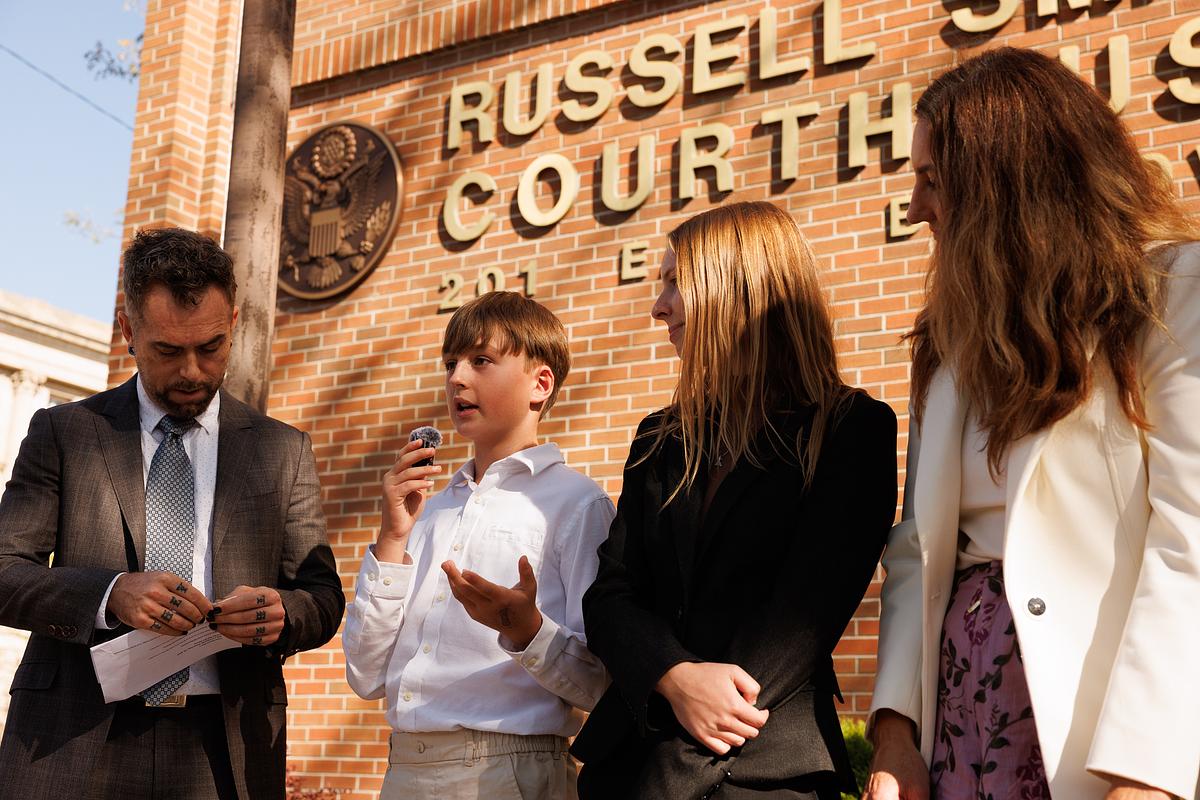
Twenty young Americans attempting to block President Donald Trump’s efforts to “unleash” American energy are asking the 9th U.S. Circuit Court of Appeals to reverse a lower court’s dismissal of their constitutional climate case.
The plaintiffs argued in a brief filed Monday that federal courts have jurisdiction to block the executive orders. Without action by the judicial branch, the “children’s health emergency” they’ve described in their litigation will only worsen, they maintain.
Lead plaintiff Eva Lighthiser, a 19-year-old Livingston resident, wrote in a press release Tuesday that she and her co-plaintiffs are seeking recourse from federal courts because the government’s checks and balances “have failed us.”
“These executive orders are directly harming me and my fellow plaintiffs. Every additional wildfire, smoky day, flood puts our lives and health at risk,” Lighthiser wrote. “With this appeal, we have hope that the Ninth Circuit will uphold its constitutional duty to protect the nation’s young people.”
RELATED
Judge dismisses federal lawsuit from young climate activists
A federal judge in Montana has dismissed a lawsuit from young climate activists seeking to block President Donald Trump’s executive orders promoting fossil fuels. The activists claimed the orders will worsen global warming, threatening their lives and violating their constitutional rights. Attorneys for the U.S. Department of Justice and more than a dozen states urged Judge Dana Christensen in Missoula to dismiss the case. The activists included youths who were victorious in a landmark climate trial against Montana, where the state constitution declares a “right to a clean and healthful environment.” That language is absent from the U.S. Constitution.
The 77-page lawsuit argues that district courts across the country have blocked Trump’s executive orders and asserts that the federal court system in Montana is well within its authority to reverse three fossil fuel-centric executive orders Trump issued within months of entering the White House for a second term. The lawsuit also argues that the facts at issue are “straightforward” and that the challenged orders are “discrete” policies that can, and should, be reversed to uphold the plaintiffs’ constitutional rights.
The appeal comes after a two-day hearing in Missoula last September. During that hearing, expert witnesses for the plaintiffs argued that the executive orders will drive up greenhouse gas emissions, generating a series of economic and public health risks that will be “uniquely and disproportionately” borne by young people. Several of the plaintiffs, who live across the United States, took to the stand to describe how flooding, wildfire and other extreme weather events linked to climate change have threatened their physical and mental health.
The government’s attorneys countered at the hearing that the plaintiffs lacked standing to bring the lawsuit. They also argued that the plaintiffs have sought relief without precedent: the overturning of one administration’s reversal of its predecessor’s policies.
The Montana Department of Justice, which intervened in the litigation alongside more than a dozen other states, argued that a ruling in favor of the plaintiffs could hinder energy projects in Montana and cost the state money if it has to become involved in further litigation.
A month after the hearing, U.S. District Court Judge Dana Christensen found that the plaintiffs had presented “overwhelming evidence” that climate change was affecting them and that Trump’s orders will worsen it, but concluded that the remedy lies with policymakers — e.g., legislators and government officials — rather than judges. Christensen likened the case to Juliana v. United States, a prominent federal climate lawsuit that was decided in the government’s favor last year after more than a decade of litigation.
related
Youth plaintiffs challenging Trump energy orders ‘optimistic’ after days in court
The three executive orders at issue in the case, issued by President Donald Trump earlier this year, direct federal agencies to reverse actions that place an “undue burden” on the development of domestic energy sources, facilitate energy companies’ access to federally owned energy sources and to prioritize coal-fired electricity. The Trump administration has said the changes are necessary to address what it calls the nation’s inadequate generation capacity and Biden policies that increased energy prices.
White House spokesperson Taylor Rogers wrote in an emailed statement to Montana Free Press on Tuesday afternoon that Trump will “continue to unleash American energy” as part of his effort to end “Joe Biden’s war on American energy, which gave preferential treatment to certain sectors of the industry.” Rodgers also wrote that Trump’s energy policies aim to protect Americans’ economic and national security interests.
It’s unclear if the Montana Department of Justice, which intervened to back the federal government in the district court case, will also intervene in the appeal. A spokesperson for Montana Attorney General Austin Knudsen did not respond to MTFP’s request for comment by publication time Tuesday evening.
Ten of the plaintiffs in the Lighthiser v. Trump lawsuit were involved in another prominent piece of constitutional climate litigation: they appeared in the multi-year Held v. Montana lawsuit that challenged the state government’s approach to permitting fossil fuel projects.
In 2024, the Montana Supreme Court sided with the plaintiffs in that litigation, which found that the Montanans’ right to a “clean and healthful environment” includes the right to a “stable climate system.”
Last year, most of the Held v. Montana plaintiffs challenged the Montana Legislature’s response to the Supreme Court’s ruling, arguing that legislation lawmakers adopted in the wake of the order doesn’t comply with the spirit of the judges’ findings. The plaintiffs brought their litigation directly to the Montana Supreme Court, asserting that the relevant facts have already been established and immediate review by the state’s highest court was warranted because the plaintiffs are experiencing climate harms “right now” and they will only intensify with more time.
Last month, the Supreme Court denied the plaintiffs’ motion in the “Held v. Montana II” litigation, finding that district courts are well-equipped to consider the types of constitutional issues plaintiffs raised in their filing.
LATEST STORIES
How Trump tariffs jolted Montana coffee roasters
The first year of President Donald Trump’s second term is giving Helena coffee roaster Steven Ladefoged the wrong kind of jitters.
Gianforte extends deadline for landlords to avoid second-home tax
Gov. Greg Gianforte that a “technical glitch” has spurred the state to extend an application deadline that thousands of Montana landlords need to meet in order to avoid the state’s new second-home tax. The deadline, which had been set for March 1, has now been pushed back to midnight on March 20.
Montana ranks 7th for U.S. Olympians per capita
Montana ranks seventh in the nation for the number of Olympic athletes by birthplace on a per-capita basis since 1924, placing the state behind Alaska and New Hampshire and ahead of New York and Rhode Island.