

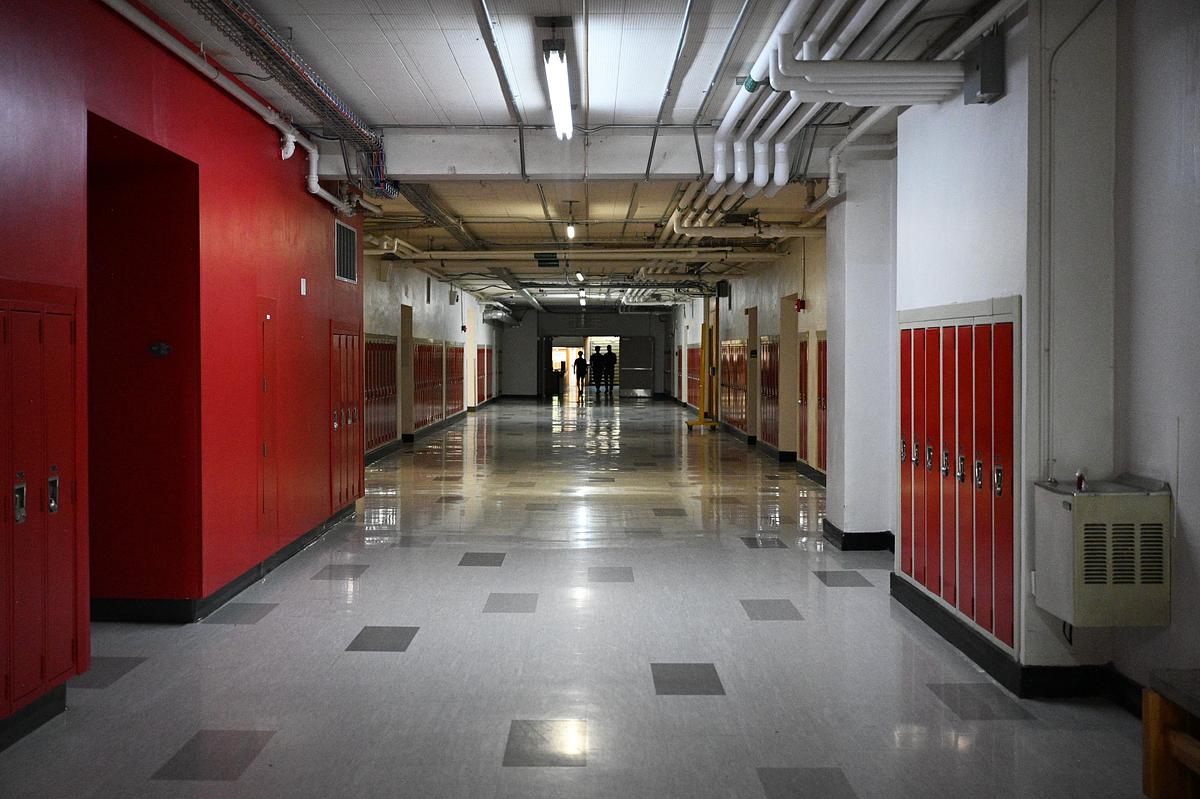
An education coalition that had planned to pitch a statewide sales tax to a committee studying the state’s school funding system reversed course before presenting the idea at a formal meeting after fielding resistance from other education advocates.
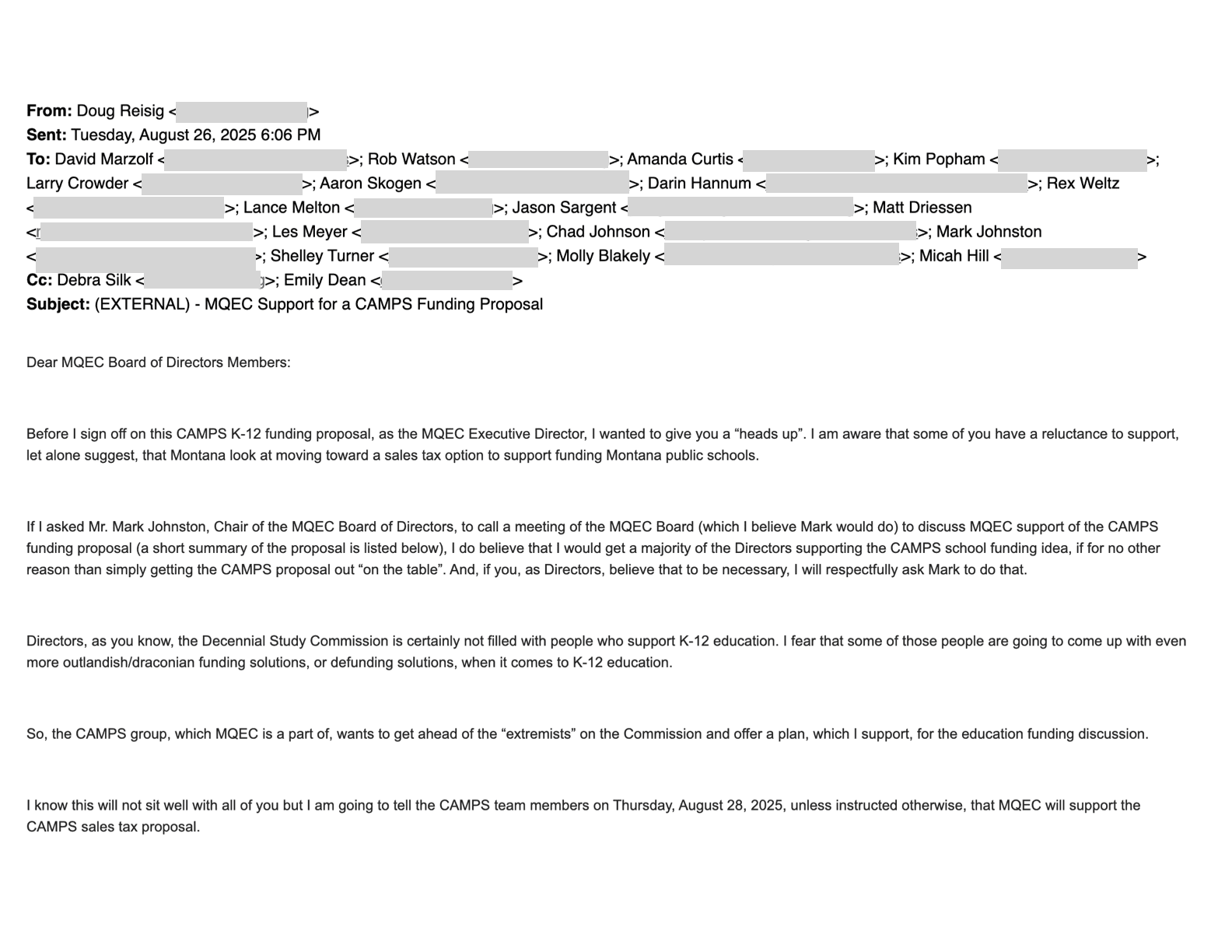
Doug Reisig, the executive director of the Montana Quality Education Coalition, emailed members of his organization Aug. 26 to tell them his group planned to endorse a statewide sales tax in order to eliminate many property taxes that currently fund education. MQEC would make that suggestion, Reisig wrote, to the interim legislative committee tasked with studying how schools in Montana are funded, according to an email he sent to MQEC’s board of directors and that was obtained by Montana Free Press.
But last week, two days after MTFP asked Reisig about the proposal, he said that he had “been instructed to hold off on that statement of support” until his board of directors convenes to discuss the issue.
In decades past, Montanans have voted against sales tax proposals consistently enough that the concept is widely considered a third rail in the state’s political circles.
Montana’s School Funding Interim Commission, a group of legislators, politically appointed advocates and representatives from the Office of Public Instruction, recently began its decennial meetings to discuss how public K-12 schools are funded and draft recommendations for the 2027 Legislature to consider. Reisig’s email indicated he intended to lobby for a sales tax at the commission, a group he believes is “certainly not filled with people who support K-12 education,” according to the email.
“I fear that some of those people are going to come up with even more outlandish/draconian funding solutions, or defunding solutions, when it comes to K-12 education,” Reisig wrote. “So, the [Coalition of Advocates for Montana Public Schools] group, which MQEC is a part of, wants to get ahead of the ‘extremists’ on the Commission and offer a plan, which I support, for the education funding discussion.”
Rep. Brad Barker, R-Red Lodge, brought a similar proposal to the 2025 Legislature. His bills, which ultimately died in committee, would have called for a referendum on whether to implement a sales tax on the condition that the revenue be directed toward education. Barker also sits on the School Funding Interim Commission.
Lance Melton, an MQEC board member who also serves as the executive director of the Montana School Board Association, helped draft the 2025 legislation.
“It’s all about a combination of providing relief to property taxes and then making sure that schools have adequate resources to provide quality education,” Melton said in an interview with Montana Free Press. Property taxes in Montana have risen around the state recently, leading lawmakers to pass a second-home tax in the 2025 legislative session aimed at providing relief for primary homeowners.
RELATED

Time for an ‘adult conversation’ about a Montana-wide sales tax?
For generations, Montana voters have been famously averse to the notion of a statewide sales tax, repeatedly rebuffing efforts by political leaders to persuade them that one would be good medicine for the state’s public finances. The head of the state’s most prominent business group says a changing economy means it’s time to give the idea another go.
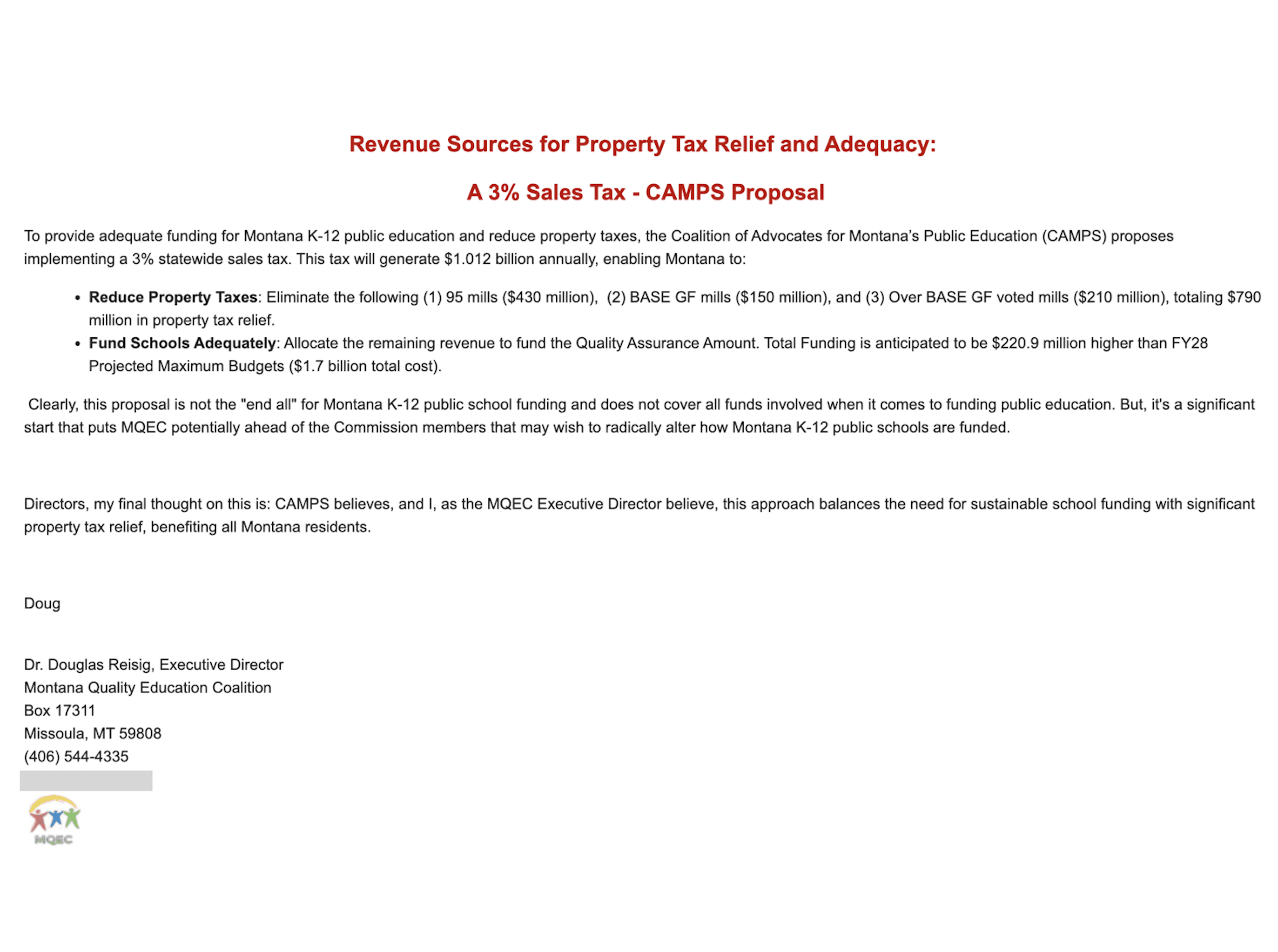
Melton, Barker and Reisig all rely on similar estimates in their pitches: a 3% statewide sales tax would generate about $1 billion annually. That would, in theory, be enough to eliminate many local school taxes, including the 95 mills collected statewide to help equalize funding between districts, and still have enough left over to increase school funding by about $200 million.
Reisig wrote to his board that he anticipated internal pushback.
“I am aware that some of you have a reluctance to support, let alone suggest, that Montana look at moving toward a sales tax option to support funding Montana public schools,” Reisig wrote.
Amanda Curtis, an MQEC board member who also serves as the president of Montana’s public employees union, wrote in a text to MTFP on Aug. 28 that “this is not the best or the only solution to school funding.” Curtis heads the Montana Federation of Public Employees, which lobbied against Barker’s 2025 legislation.
“By eliminating the 95 mills and replacing [them] with a regressive sales tax, the biggest winner will be corporations, while low and moderate income Montanans we serve in public schools will pay instead,” Curtis said. “I cannot join in on a plan that will further push the tax responsibility to school employees and the families we serve.”
Sales tax critics often argue that such broad-based sales taxes are regressive because they could mean low-income individuals pay more relative to their income than they do under the existing tax system.
Assorted education advocates are not the only groups entertaining conversations about a sales tax. Montana Chamber of Commerce President Todd O’Hair, for example, has said he believes it is time for Montana to have an “adult conversation” about sales tax.
“Everything needs to be on the table,” O’Hair told MTFP in an interview last month. “I don’t think we have the luxury anymore of starting a tax reform discussion by saying ‘We’re going to take this off the table, we’re going to take that off the table.’”
LATEST STORIES
City aims to better fund affordable housing under updated policy
City’s median home price dipped in 2025.
Coffee tariff jitters
PLUS: Could a flat tax be Gianforte’s last act?
Gianforte extends deadline for landlords to avoid second-home tax
Gov. Greg Gianforte that a “technical glitch” has spurred the state to extend an application deadline that thousands of Montana landlords need to meet in order to avoid the state’s new second-home tax. The deadline, which had been set for March 1, has now been pushed back to midnight on March 20.